
By AGILE Consulting Engineers, Solar PV and Battery Energy Storage Systems (BESS) specialists.
Design a mining or off-grid power system the way you would design a grid-connected suburban solar farm and it will fail, not eventually, but during the first major dust event or the first week the resupply truck cannot get through. Remote and mine site power systems are not a scaled-down version of grid-connected design. They are a different design problem, with diesel displacement economics, environmental severity, and logistics driving decisions that grid-connected projects rarely have to consider.
Table of Contents
- Why Off-Grid Design Is a Different Problem
- Diesel Displacement and Hybrid System Integration
- Harsher Environmental Conditions
- Logistics and Transportability
- Reduced Grid Support and Weak or No Grid Connection
- Control System Considerations for Microgrids
- Staging for a Life of Mine or Operational Horizon
- What to Do Next
- FAQ
Why Off-Grid Design Is a Different Problem
A grid-connected solar and Battery Energy Storage System (BESS) project can lean on the wider network for frequency and voltage support, fault current, and a level of forgiveness if the plant’s output varies from moment to moment. An off-grid or mine site power system does not have that luxury. In many cases the solar, battery, and diesel generation on site are the entire electricity supply for the operation, which means the design has to account for stability, protection, and reliability functions that a grid-connected plant would otherwise share with the broader network. Detailed design for these sites has to treat the power system as a self-contained ecosystem rather than one generator among many on a large interconnected grid.
Diesel Displacement and Hybrid System Integration
Most remote and mining power systems are not solar and BESS in isolation, they are hybrid systems where solar and battery storage are layered onto an existing or new diesel generation fleet with the specific aim of reducing fuel consumption. The general operating principle is straightforward to state and considerably harder to implement well: solar generation is used first when available, the battery smooths variability and covers short gaps, and diesel generation is retained as the flexible, dispatchable backbone that steps in when solar and storage cannot meet demand. Done well, this sequencing can meaningfully cut diesel consumption at a site; publicly documented Australian examples of large hybrid mine site systems, such as the solar and battery installation integrated with the diesel power station at the DeGrussa copper mine in Western Australia, have reported diesel displacement and multi-million litre annual fuel savings from a hybrid configuration of that scale. Results at any given site depend heavily on load profile, solar resource, battery sizing, and how tightly the hybrid controls are integrated with the existing generation fleet, so displacement outcomes should always be modelled for the specific site rather than assumed from another project’s figures.
Integrating solar and BESS with an existing diesel fleet raises design questions that a greenfield hybrid system does not face in the same way, including how the new generation sources will be synchronised with existing generator controls, how protection coordination will work across old and new equipment, and whether the existing switchboard and control infrastructure can accommodate the additional metering, communications, and control interfaces the hybrid system needs.
Harsher Environmental Conditions
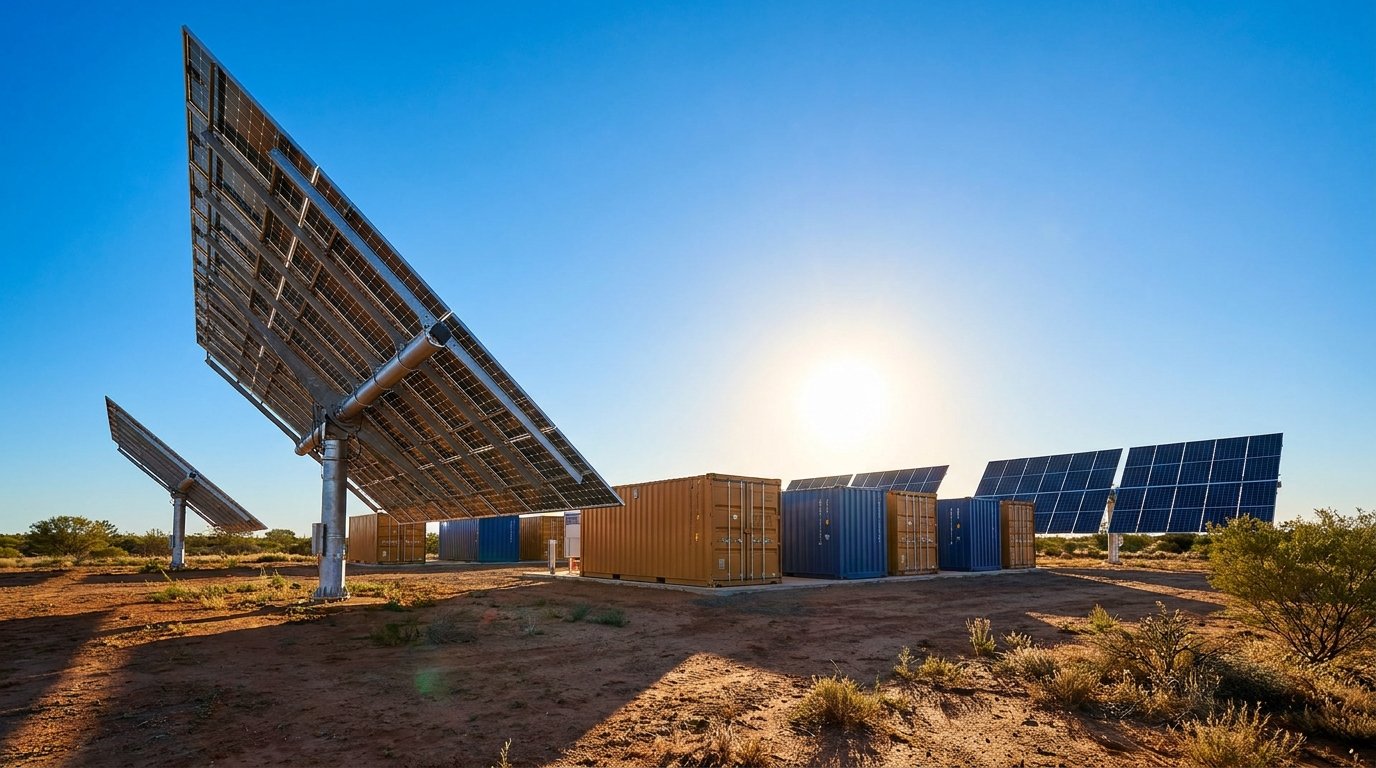
Remote and mining sites in Australia routinely present environmental conditions well outside what a typical grid-connected solar farm on cleared agricultural land experiences. Dust ingress affects everything from panel soiling losses to enclosure ratings for switchgear and battery containers. Elevated ambient temperatures affect equipment derating, particularly for battery systems where thermal management has a direct bearing on both performance and safety margins. Wind loading in exposed inland and coastal remote areas can exceed standard assumptions, and drainage design has to account for conditions ranging from prolonged dry periods to intense, infrequent rainfall events typical of much of remote Australia. None of this is exotic engineering, but it does mean equipment selection, enclosure ratings, and civil design all need to be assessed against the specific site’s conditions rather than a generic specification, and that soiling, derating, and thermal assumptions used in the energy yield model need to reflect what the site will actually experience rather than a standard climate file.
Logistics and Transportability
Getting equipment to a remote site is frequently as significant a design constraint as the electrical engineering itself. Component sizing, packaging, and weight have to be considered against realistic transport modes and access routes, which for many mine sites means road train, barge, or in some cases air freight, each with its own dimensional and weight limitations. Modular and transportable design approaches, where major equipment such as battery containers and switchrooms are pre-assembled and tested before shipping, are common in this context precisely because they reduce the amount of skilled labour and time required on site, where mobilising specialist crews is expensive and scheduling around site access windows is a real constraint. Detailed design for these sites has to consider not just how the system will operate once commissioned, but how every major component will physically get there, what installation sequence is feasible given site access, and what spare parts and consumables logistics look like over the operating life of the asset, given that resupply is rarely as simple as a same-day delivery.
Reduced Grid Support and Weak or No Grid Connection
Where a remote or mine site does have some grid connection, it is often what engineers describe as a weak grid, meaning a network with limited fault level and voltage support capacity relative to the generation being connected. This changes protection coordination, power quality, and stability design considerably compared with a strong grid connection point. Where there is no grid connection at all, the on-site generation assets, working together, have to provide functions that a strong grid would otherwise contribute, including frequency regulation and voltage support, which places specific demands on the BESS power conversion system (PCS) and the overall control architecture. These are genuinely specialist design considerations, and getting them wrong does not just reduce performance, it can compromise the stability of the entire site’s power supply, which for an operating mine has direct safety and production implications.
Control System Considerations for Microgrids
A hybrid mine site or off-grid power system functions as a microgrid, and the control philosophy for a microgrid has to define how the system behaves across a wider range of conditions than a simple grid-connected plant, including how generation sources share load in real time, how the system responds if a generation source trips unexpectedly, and how black start, where the system needs to be restarted from a fully de-energised state without external grid support, is managed if required. These are conceptual design considerations that shape the overall control architecture; the detailed control loop tuning and protection settings that implement them are a specialist controls engineering task that sits alongside, rather than replaces, the broader detailed design process.
Staging for a Life of Mine or Operational Horizon
Mining operations have a defined life of mine, and remote site loads can change materially as an operation ramps up, expands, or scales down. Detailed design for these sites benefits from being staged with that trajectory in mind, considering whether the power system needs to be expandable, whether equipment should be selected with relocation or redeployment to a future site in mind, and how the design accommodates load growth without requiring a full redesign partway through the operation’s life. This is a different planning horizon to most grid-connected commercial projects, and it is worth raising explicitly with your design team at the outset rather than assuming a standard approach will fit.
What to Do Next
Off-grid and mine site power system design rewards experience with the specific constraints these sites present, from diesel hybrid integration through to transport logistics and weak grid stability. AGILE’s solar and BESS system design service covers the electrical, structural, and civil disciplines needed for remote and hybrid power systems, and can work through the specific environmental, logistics, and grid support considerations that apply to your site.
FAQ
How much diesel can a solar and BESS hybrid system realistically displace at a mine site?
Displacement varies considerably by site depending on load profile, solar resource, and system sizing, and documented Australian hybrid mine site projects have shown meaningful fuel savings at scale, but any figure for a specific site should come from dedicated energy modelling rather than a general industry figure.
What makes battery design different at a remote or mining site compared to a grid-connected site?
Thermal management, dust and enclosure ratings, and protection design all need to account for more severe environmental conditions, and the battery system may also need to contribute stability functions that a strong grid would otherwise provide.
Why does transportability matter in detailed design for remote sites?
Equipment has to reach the site via constrained transport modes such as road train, barge, or air freight, so component sizing, packaging, and modular assembly are genuine design constraints, not just logistics planning that happens after design is finished.
What is a weak grid and why does it matter for mine site design?
A weak grid has limited fault level and voltage support capacity relative to the generation connecting to it, which changes protection coordination and stability design compared with a strong grid connection, and is common at remote and regional connection points.
Does an off-grid power system need a different control philosophy to a grid-connected plant?
Yes. A microgrid without strong external grid support has to manage functions such as load sharing between generation sources and response to a tripped generator that a grid-connected plant can otherwise rely on the network to help absorb.
Should mine site power systems be designed for the full life of the operation from day one?
It is generally worth staging the design around the site’s expected load trajectory and operational horizon, considering expandability or relocation potential, rather than assuming a fixed, unchanging system size for the life of the mine.
