
The concept of a Virtual Power Plant (VPP) sounds straightforward. Aggregate distributed energy resources, coordinate their dispatch, and sell the combined output into the grid or ancillary services markets. In practice, the engineering required to do this reliably, safely, and in compliance with Australian grid requirements is considerably more complex than the concept suggests.
AGILE Consulting Engineers provides independent VPP engineering and integration advisory services across Australia. We work with asset owners, energy retailers, and project developers to assess VPP feasibility, design control architectures, review Energy Management System (EMS) and SCADA integration, and provide technical oversight during commissioning of multi-site virtual power plant deployments.
A Virtual Power Plant is a coordinated network of distributed energy resources, typically a combination of solar PV generation, Battery Energy Storage Systems (BESS), and controllable loads, managed through a software platform to behave as a single, dispatchable generation or demand response asset.
VPPs can participate in the National Electricity Market (NEM) through wholesale energy trading, Frequency Control Ancillary Services (FCAS) markets, and Demand Response Mechanism (DRM) schemes. They can also provide grid support services such as voltage control and export management at a local network level, in coordination with the relevant Distribution Network Service Provider (DNSP).
The scale of VPP deployment in Australia has grown significantly. AEMO’s 2024 Integrated System Plan identifies Distributed Energy Resources (DER) aggregation as a material component of the grid’s future flexibility stack. Several states have supported VPP trial programs, and the technology is now moving beyond the trial phase into commercial deployment.
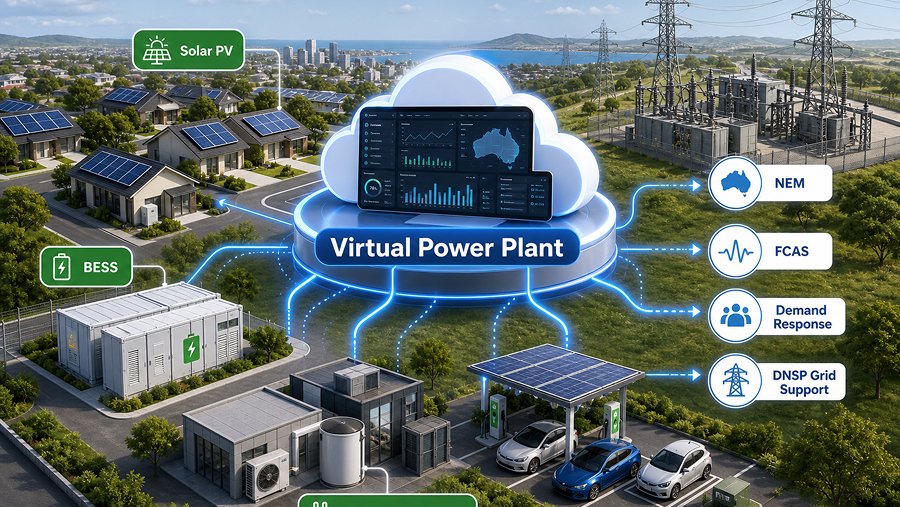
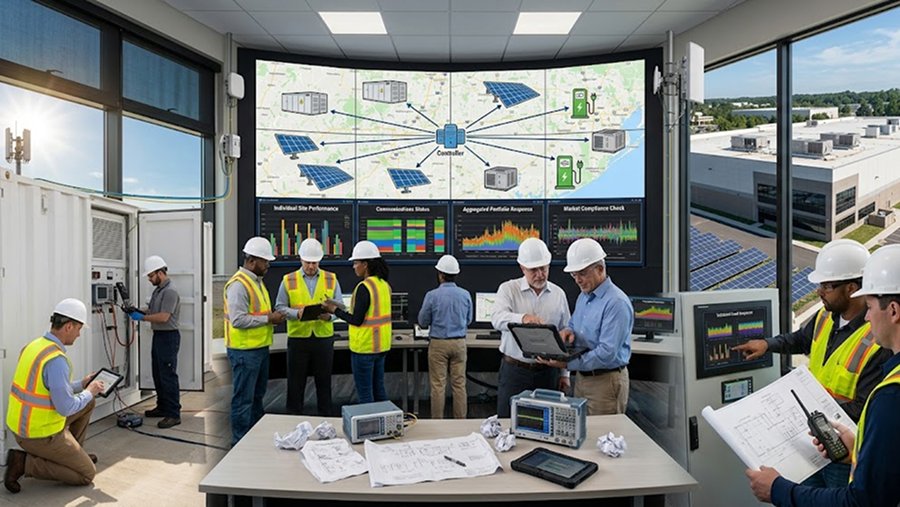
A common misconception is that VPP deployment is primarily a software and communications challenge. It is not. The physical assets in a VPP, the individual BESS units, solar inverters, and loads at each site, must be technically capable of responding to dispatch signals within the required timeframe and at the required accuracy. The communications infrastructure must be reliable and secure. And the aggregated behaviour of the portfolio must comply with the grid connection obligations of the VPP’s registered market participant entity.
This is where engineering rigour matters. An EMS dispatch algorithm that looks correct in simulation can produce unexpected grid behaviour in deployment if the individual site inverter response characteristics are not adequately characterised. We have seen VPP integration projects where the assumed response time of individual BESS units was inconsistent with the equipment’s actual tested performance, with consequences for FCAS market compliance.
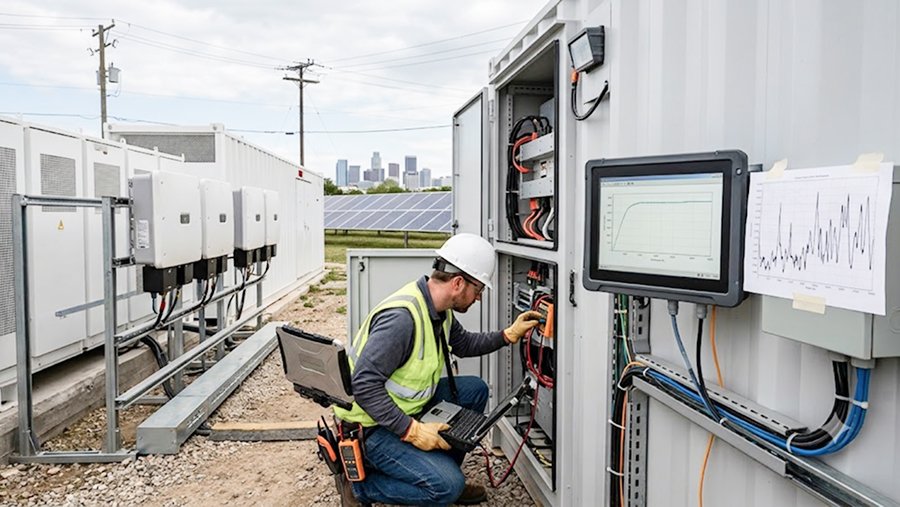
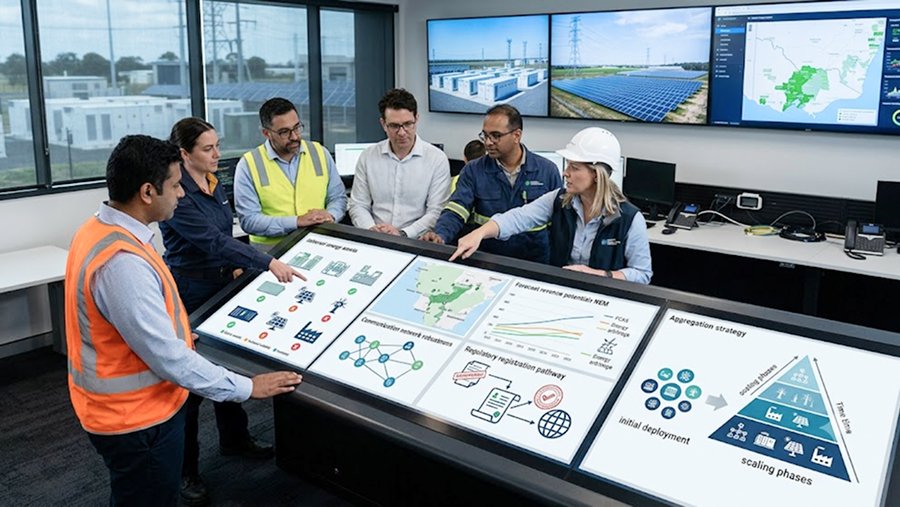
We assess the technical and commercial feasibility of VPP development for a given portfolio of assets. This includes evaluating the technical specifications of the individual assets for VPP suitability, assessing the communications infrastructure requirements, modelling revenue potential across relevant NEM market products, and identifying the regulatory pathway for market registration.
We also advise on the aggregation strategy, including which asset types and which sites to include in the initial deployment, and how to structure the VPP so that it can scale as additional assets are added.
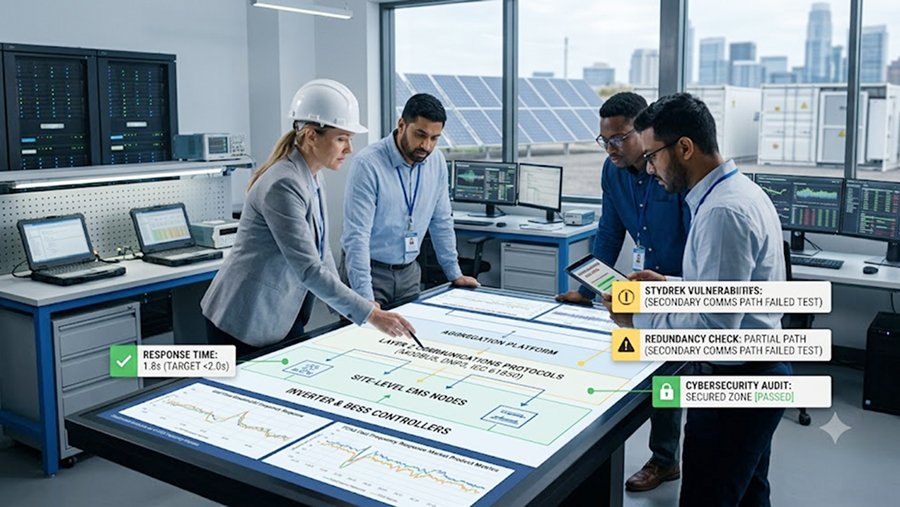
The control architecture of a VPP determines how dispatch signals flow from the aggregation platform to the individual assets. We review the proposed control hierarchy, including the aggregation platform, site-level EMS units, inverter and BESS controllers, and the communications protocols between layers.
We assess whether the control architecture can meet the response time and accuracy requirements for the intended market products, whether it has adequate redundancy for high-availability operation, and whether the cybersecurity posture is appropriate for a grid-connected distributed asset network.
VPP participation in the NEM requires compliance with AEMO’s technical requirements for registered participants. We provide technical advisory on generator performance standards as they apply to VPP assets, export control and constraint management at individual connection points, and the interface between the VPP aggregation platform and AEMO’s dispatch and settlement systems.
For projects interfacing with a DNSP for local network services, we assist with the technical specification and negotiation of the network support agreement.
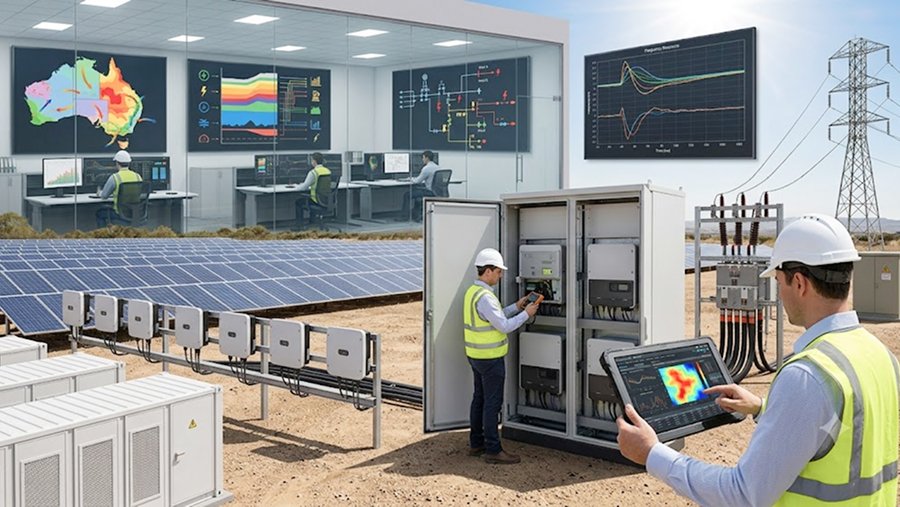
Commissioning a VPP is not like commissioning a single site. Each participating asset must be individually tested and verified, the communications infrastructure must be validated end-to-end, and the aggregated response of the portfolio must be tested against the performance requirements for the intended market products.
We provide Owner’s Engineer oversight during VPP commissioning, including test plan development and review, witnessing of individual site acceptance tests, and validation of the aggregated portfolio response.
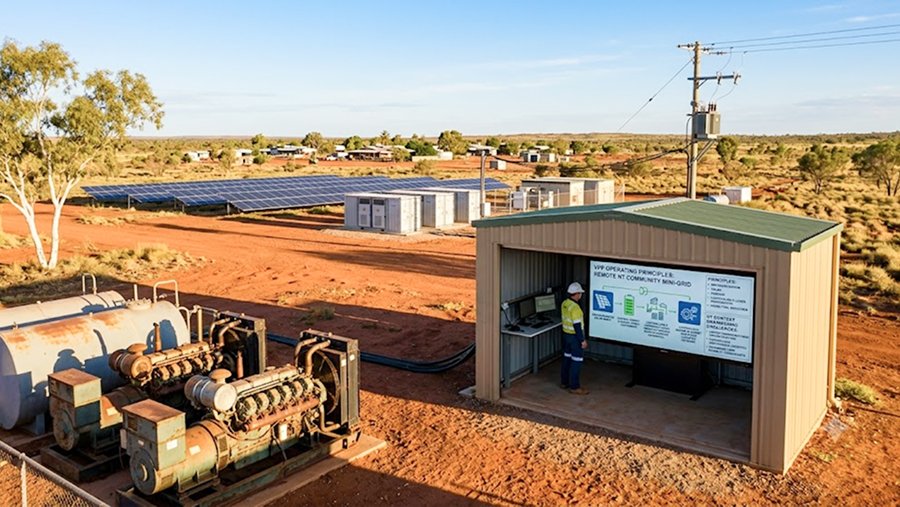
The Northern Territory’s electricity network operates independently of the NEM and is not subject to the same market structures. However, the principles of DER aggregation are directly applicable to the NT context, particularly for remote community power systems where aggregating solar, storage, and controllable loads can significantly reduce diesel fuel consumption and improve supply reliability.
We have experience applying VPP principles to remote NT community energy systems, where the engineering challenges include limited communications infrastructure, constrained logistics for equipment maintenance, and grid stability constraints that are more demanding than those encountered in the NEM.
If you are assessing a VPP deployment and are not certain whether your individual assets are technically capable of meeting the market product response requirements, that is a question worth resolving before you commit to the aggregation platform. We are happy to outline what a pre-deployment technical assessment looks like.
There is no absolute minimum, but the economics of VPP registration and management overhead mean that very small portfolios are difficult to justify commercially. In practice, most commercial VPP deployments involve either a large number of small residential assets or a smaller number of commercial and industrial BESS installations with meaningful individual capacity. The right scale depends on the target market product and the aggregation platform’s cost structure.
Sometimes. The critical questions are whether existing inverters and BESS units support the communications protocols required by the aggregation platform, whether they can respond within the required timeframe for the intended market products, and whether the connection agreements at each site permit VPP participation. These questions need to be assessed on a site-by-site basis.
Frequency Control Ancillary Services (FCAS) in the NEM require a registered market participant to provide frequency response within defined timeframes, from seconds for fast raise/lower services to tens of seconds for slower products. A VPP can provide FCAS by aggregating the fast response capability of individual BESS units. The technical challenge is ensuring that the aggregated response is consistent and reliable, since AEMO measures performance and applies compliance charges for underperformance.
Requirements vary with the aggregation platform and individual assets, but in general a VPP requires reliable, low-latency communications between each site and the central aggregation platform. 4G/LTE cellular connectivity is common for distributed residential assets. Dedicated fibre or ethernet is more typical for commercial and industrial BESS sites. Cybersecurity requirements are an important design consideration.
Yes. We apply VPP engineering principles to projects in the Northern Territory and in Pacific island nations, where the market structure is different but the technical challenges of aggregating distributed energy resources are analogous. In off-grid contexts, the focus shifts from market participation to system stability and diesel displacement.
Contact AGILE Consulting Engineers to discuss your VPP engineering requirements. We provide independent technical advisory from feasibility through to commissioning and operational support.