
By AGILE Consulting Engineers, Solar PV and Battery Energy Storage Systems (BESS) specialists.
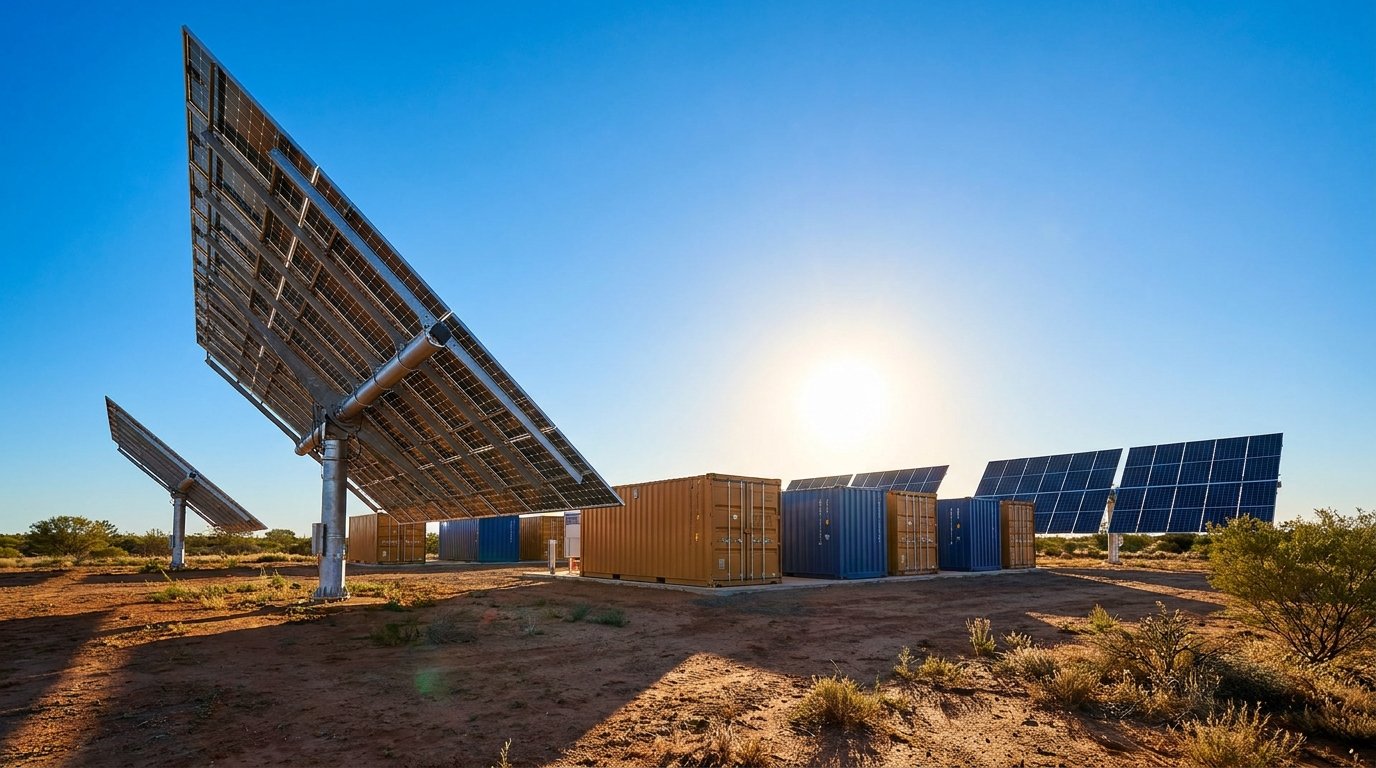
A remote Northern Territory community running on diesel gensets is not a smaller version of a NEM-connected town, it is a different engineering problem entirely. The Borroloola Ngardara project, a 2.1 MW solar array paired with a 1.8 MW / 6.6 MWh BESS, is expected to displace around 1.2 million litres of diesel a year over its 25-year life and push renewable penetration to roughly 80 per cent, according to pv magazine Australia’s May 2025 reporting. Numbers like that only get delivered if the engineering behind them accounts for how differently an islanded, diesel-backed microgrid behaves compared with a grid-connected battery.
Table of Contents
- Why Off-Grid BESS Is a Different Engineering Problem
- The Diesel Displacement Case in the NT
- Grid Stability and Islanded Microgrid Control
- Sizing for Reliability, Not Just Renewable Penetration
- Logistics, Wet Season Access and Construction Constraints
- Battery Chemistry and Climate Considerations
- Funding Pathways Supporting Remote Microgrids
- What to Do Next
- FAQ
Why Off-Grid BESS Is a Different Engineering Problem
On the National Electricity Market (NEM), a BESS operates alongside a large, synchronous grid that already provides frequency and voltage reference, fault current and inertia. A remote NT microgrid usually has none of that as a given. The system itself, whether that’s a diesel genset, a battery’s Power Conversion System (PCS), or both together, has to create and hold the grid, not just participate in one. That single difference changes control philosophy, protection design, sizing methodology and commissioning requirements from the ground up, which is why off-grid BESS work is treated as its own discipline rather than a scaled-down version of utility design.
The Diesel Displacement Case in the NT
Diesel haulage into remote communities is expensive and logistically fragile, so the economic case for solar-plus-storage in the NT is usually straightforward once transport costs are factored in. The NT Remote Power System Strategy has set a target of 70 per cent renewable electricity generation for Indigenous Essential Services communities by 2030, replacing ageing diesel infrastructure with a mix of solar, battery storage and, in many cases, retained diesel for backup and firming. Projects like Borroloola illustrate what that looks like in practice: enough battery capacity to carry the community through periods without sufficient solar generation, with diesel gensets retained as backup rather than the primary source.
Grid Stability and Islanded Microgrid Control
Weak or islanded grids are unforgiving of poor system strength. Without a large synchronous machine setting the frequency and voltage reference, a microgrid depends on grid-forming inverter control within the BESS’s PCS, or coordinated operation between the battery and diesel gensets, to remain stable through load changes and cloud transients. AEMO’s 2026 reporting on the NEM battery pipeline shows grid-forming capability becoming the norm even in grid-connected systems, and the underlying reasoning applies even more directly off-grid: a microgrid with no external reference has to generate its own stability, and the Energy Management System (EMS) and Supervisory Control and Data Acquisition (SCADA) architecture managing the handover between diesel and battery-led operation needs to be designed for that from day one, not retrofitted after commissioning problems appear.
Sizing for Reliability, Not Just Renewable Penetration
It’s tempting to size a remote BESS purely against a renewable penetration target, but reliability of supply to the community has to come first. That means modelling consecutive low-solar days, seasonal load variation (air conditioning demand in the build-up and wet season is a genuine driver in northern Australia), and the state of health degradation the battery will experience over its design life, not just an average day’s generation profile. Our detailed design work on solar and BESS detailed design for mining and off-grid sites goes into how that sizing methodology differs from a grid-connected project.
Logistics, Wet Season Access and Construction Constraints
Northern Australia’s wet season, roughly November to April, closes many unsealed roads into remote communities and can restrict barge access to coastal sites, which compresses the practical construction window into the dry season months. Battery containers, transformers and switchgear need to be on site, and often pre-tested, before those access windows close, which pushes procurement and freight planning earlier into the programme than a metropolitan project would require. Site access constraints also shape maintenance planning once the system is operational, since a fault that would be a same-day callout in a capital city can mean a multi-week wait for parts or specialist technicians in the NT.
Battery Chemistry and Climate Considerations
Remote sites in northern Australia see sustained high ambient temperatures and, at some locations, long idle periods between duty cycles, both of which affect battery chemistry selection and thermal management design. Lithium iron phosphate (LFP) remains the dominant chemistry in Australian BESS deployments generally, but sodium-ion technology is emerging as a genuine alternative for remote applications specifically. Sodium-ion cells tolerate a wide temperature range, reportedly around minus 40 to plus 70 degrees Celsius, and can sit at zero state of charge without degrading, characteristics that suit remote sites where standby resilience matters as much as cycling performance. As of mid-2026 the technology is still early in Australian deployment and not yet Clean Energy Council approved for rebate-eligible residential systems, so chemistry choice for any given remote project needs to be assessed against what’s actually commercially available and warrantable at the time.
Funding Pathways Supporting Remote Microgrids
Remote NT microgrids are rarely funded purely on a commercial basis, and a layered funding structure combining government programmes, utility capital and, in some cases, community equity is common. The Australian Renewable Energy Agency’s (ARENA) Regional Microgrid Program, a $125 million initiative, and a further $17.1 million committed to First Nations-led microgrids in April 2026, are examples of the funding support available specifically for these projects. Understanding what a funding body expects to see in a technical case, feasibility study or grant application is its own skill, one we cover in our guide to Northern Territory renewable energy funding opportunities.
What to Do Next
Remote and off-grid BESS projects succeed or fail on decisions made well before construction, control philosophy, sizing against reliability rather than averages, and a realistic logistics plan for the site’s access constraints. If you’re scoping a battery storage project for a remote NT or northern Australian site, AGILE’s BESS engineering service can help work through those design decisions before they’re locked into a funding application or a construction contract.
FAQ
How is off-grid BESS design different from grid-connected BESS design?
An off-grid or islanded microgrid has no external synchronous grid to provide frequency and voltage reference, so the battery’s power conversion system, often working with diesel gensets, has to establish and hold grid stability itself, which changes control, protection and commissioning requirements.
How much diesel can a remote NT microgrid realistically displace?
It depends on system size and local solar resource, but the Borroloola Ngardara project, a 2.1 MW solar and 1.8 MW / 6.6 MWh BESS system, is projected to displace around 1.2 million litres of diesel annually according to pv magazine Australia’s 2025 reporting.
Does the wet season affect BESS construction in the NT?
Yes. Unsealed road and barge access into many remote communities is constrained from roughly November to April, which compresses the practical construction window and requires procurement and freight planning to start earlier in the programme.
Is sodium-ion battery technology used in remote Australian projects yet?
It’s emerging rather than mainstream as of 2026, with early commercial deployments and mining-sector supply agreements reported, but it is not yet Clean Energy Council approved for rebate-eligible residential systems, so availability and warranty terms need to be checked for any specific project.
What funding is available for remote NT battery storage projects?
Programmes including ARENA’s Regional Microgrid Program and targeted First Nations microgrid funding support remote battery storage, generally alongside utility or government capital, and eligibility and application requirements vary by programme.
Why does grid-forming inverter capability matter more in remote microgrids?
Without a large synchronous grid providing system strength, an islanded microgrid depends on grid-forming control from the battery’s inverter, or coordination with diesel gensets, to remain stable, making it a core design requirement rather than an optional feature.
