
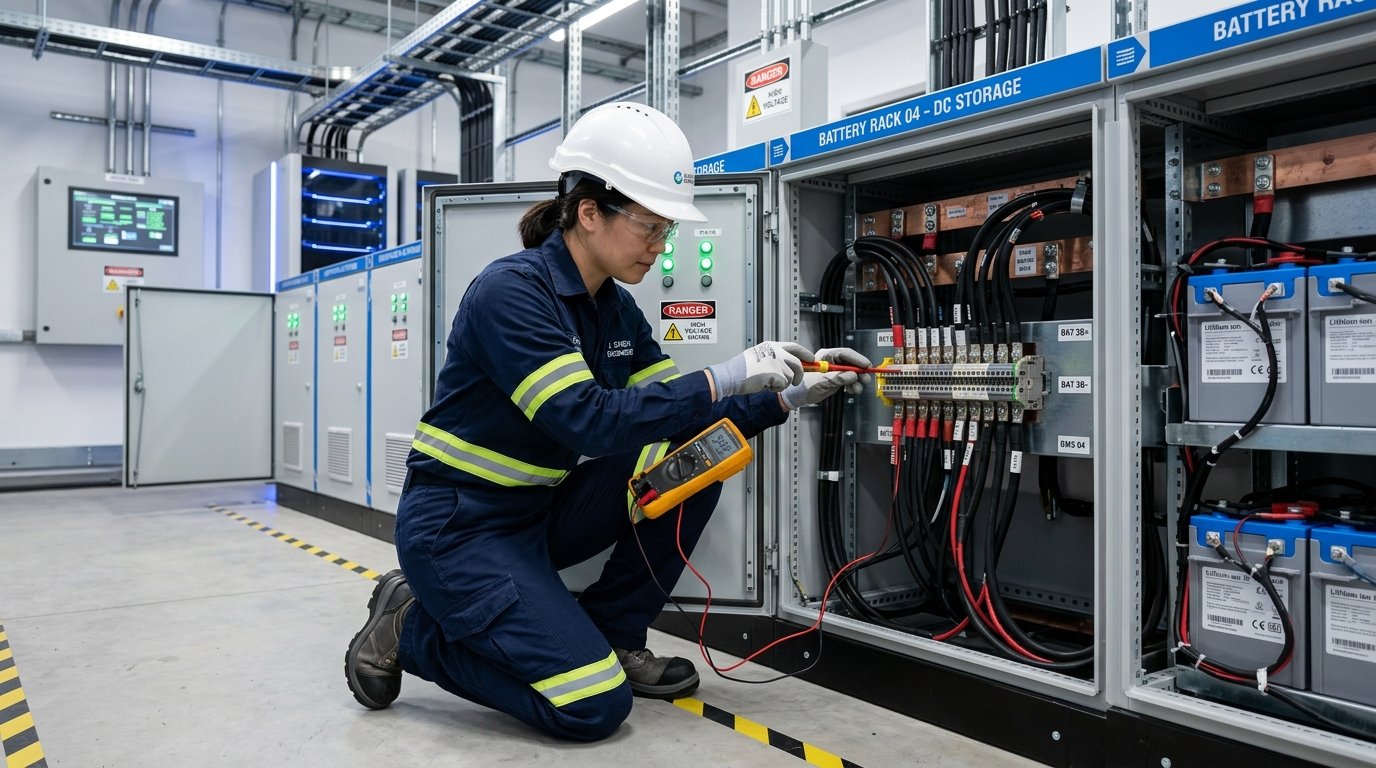
Here is a myth we hear on almost every battery project: “It passed FAT, so commissioning will be a formality.” The reality is that a factory test proves only what it was designed to prove. If the test plan was thin, the pass certificate is thin too, and the gaps surface on site, where every fix costs more and takes longer.
BESS factory acceptance testing is the structured check of a Battery Energy Storage System (BESS) at the manufacturer’s facility, before it is packed and shipped. It is the last point where the owner can see the equipment working, raise defects and have them fixed by the people who built it, in the place where the tools and spare parts are.
This article explains what a Factory Acceptance Test (FAT) is meant to achieve, where it falls short, and how Australian and Pacific projects can get real value from it.
Table of Contents
- What is BESS factory acceptance testing?
- Why FAT matters for Australian projects
- What a good FAT covers
- The honest limits of a factory test
- FAT, PSI and SAT: how they fit together
- Pacific island grids: where FAT carries more weight
- What to do next
- FAQ
What is BESS factory acceptance testing?
A FAT confirms that the main building blocks of the system behave as one integrated product before they leave the factory. On a utility scale project that usually means the battery racks and modules, the Battery Management System (BMS), the Power Conversion System (PCS), the Energy Management System (EMS), the Supervisory Control and Data Acquisition (SCADA) interface, and auxiliary systems such as Heating, Ventilation and Air Conditioning (HVAC) and fire detection.
There is no single Australian standard that sets out a FAT procedure. Its scope comes from the contract, the technical specification and the Inspection and Test Plan (ITP) agreed with the Original Equipment Manufacturer (OEM). That is why the quality of a FAT is decided months earlier, when the specification is written.
Why FAT matters for Australian projects
In the National Electricity Market (NEM), a battery has to prove itself to the Network Service Provider (NSP) and to the Australian Energy Market Operator (AEMO) during commissioning. AEMO’s Commissioning Guideline (version 1, effective 28 January 2026) notes that the NSP may require evidence of factory testing, certification or on site tests. It also sets out the hold point testing and the data needed for R2 model validation against the plant’s performance standards.
Put simply, factory records are not paperwork for the archive. They can become part of the evidence trail that supports registration and connection. A control setting or firmware version that changes after FAT without being tracked can later make test results hard to reconcile with the models submitted for connection.
Most BESS equipment is manufactured overseas, so schedule risk is real. Factory slots, shipping windows and dangerous goods logistics all interact, as we cover in our article on managing procurement, testing and long lead items. A defect found at FAT costs days. The same defect found after delivery can cost weeks, plus the cost of flying specialists to site.
What a good FAT covers
The detail varies by OEM and project, but the design intent of each test area is consistent.
| Test area | Design intent | What the owner should see |
|---|---|---|
| Integration and communications | BMS, PCS, EMS and auxiliaries recognise each other and report healthy status | All devices, sensors and meters visible on the controller and SCADA points list |
| Functional behaviour | The system follows setpoints and moves between operating modes as specified | Charge, discharge, standby and idle transitions recorded against the control narrative |
| Protection and alarms | Abnormal conditions are detected and the system responds safely | Simulated faults and communication loss produce the specified alarms, trips and recovery |
| Thermal and auxiliary systems | HVAC and fire detection operate and interlock correctly | Interlock behaviour matches the cause and effect matrix |
| Data and documentation | Every specified parameter is logged and traceable | Historical data, firmware versions, test reports and cell to pack traceability records |
Owners should also confirm that the product certifications named in the contract are current and match the equipment being built. Depending on the specification, these may include IEC 62619 for industrial lithium cells and batteries, UN 38.3 transport testing, IEC 62933-5-2 system safety requirements and UL 9540A fire test reports. Australian installation requirements, including AS/NZS 5139 where it applies, and state electrical safety rules still need to be addressed in the site design.
The honest limits of a factory test
A factory has no grid connection that matches your site. Most battery FATs are therefore partial tests. Some test benches cannot run the PCS at full rated power for a full duration, and grid behaviour such as fault ride through and voltage and frequency response can only be fully proven once connected.
That is not a reason to skip FAT. It is a reason to agree in writing, before the test, exactly which functions will be proven in the factory, which will be simulated, and which are deferred to site. Ambiguity at FAT tends to become a dispute at Site Acceptance Testing (SAT).
FAT, PSI and SAT: how they fit together
FAT proves the product works. Pre Shipment Inspection (PSI) confirms that what is packed is what was tested, in the right condition and correctly documented for transport. SAT then proves the installed system works in its real electrical environment, followed by the commissioning tests required by the NSP and AEMO.
Each stage should close out the open items of the one before. A punch list signed by both parties at the end of FAT gives SAT a clean starting point. Our owner’s engineer checklist from design review to commissioning shows how these hold points sit across the whole project. FAT witnessing and PSI form part of our BESS engineering services, alongside SAT and commissioning support.
Pacific island grids: where FAT carries more weight
On many Pacific island grids, a battery is often one of the largest assets on a small, diesel based network, and may be asked to provide grid forming support. There is less system strength to hide behind, and a control fault can affect the whole island.
Logistics also change the maths. Shipping routes are long, local spares are limited and specialist OEM technicians may be days away. A defect that might be fixed in a week on the NEM can stall a Pacific project for much longer. For these sites, a thorough FAT with clear simulation of island operating modes is one of the most cost effective risk controls available.
What to do next
If your battery is approaching manufacture, review the ITP now, while it can still be changed at little cost. Check that it reflects your control narrative, your connection requirements and your site conditions, and that you have the right to witness. This is the point where a 30 minute technical review can save months.
FAQ
What is BESS factory acceptance testing?
It is a witnessed test at the manufacturer’s facility that confirms the battery, BMS, PCS, EMS and auxiliaries work together as specified before shipping.
Is FAT mandatory in Australia?
No single standard mandates a FAT procedure. It is usually a contract requirement, and AEMO’s Commissioning Guideline notes the NSP may ask for evidence of factory testing.
Can a FAT test the battery at full power?
Often not. Factory test equipment may limit power or duration, so the test plan should state what is proven, simulated or deferred to site.
What is the difference between FAT and SAT?
FAT proves the product works in the factory. SAT proves the installed system works on site, connected to its real electrical environment.
Should the owner witness FAT in person?
Witnessing in person, or through an independent engineer, is strongly recommended for utility scale systems, because issues are cheapest to fix before shipping.
