
By AGILE Consulting Engineers, Solar PV and Battery Energy Storage Systems (BESS) specialists.
A residential Virtual Power Plant (VPP) program succeeds by aggregating thousands of small, near identical batteries into a statistically predictable fleet. A commercial and industrial (C&I) VPP has to do the opposite: extract meaningful value from a handful of large, individually engineered sites, each with its own load profile, its own network tariff structure and its own appetite for risk. The engineering conversation is almost unrecognisable from the residential case, even though both sit under the same broad VPP label.
Table of Contents
- Fewer, Larger, More Sophisticated Assets
- On Site Load as Part of the Resource
- Demand Response Potential
- Network Tariff and Network Support Opportunities
- Metering and Market Registration Complexity
- Risk, Governance and Site Specific Engineering
- What to Do Next
- FAQ
Fewer, Larger, More Sophisticated Assets
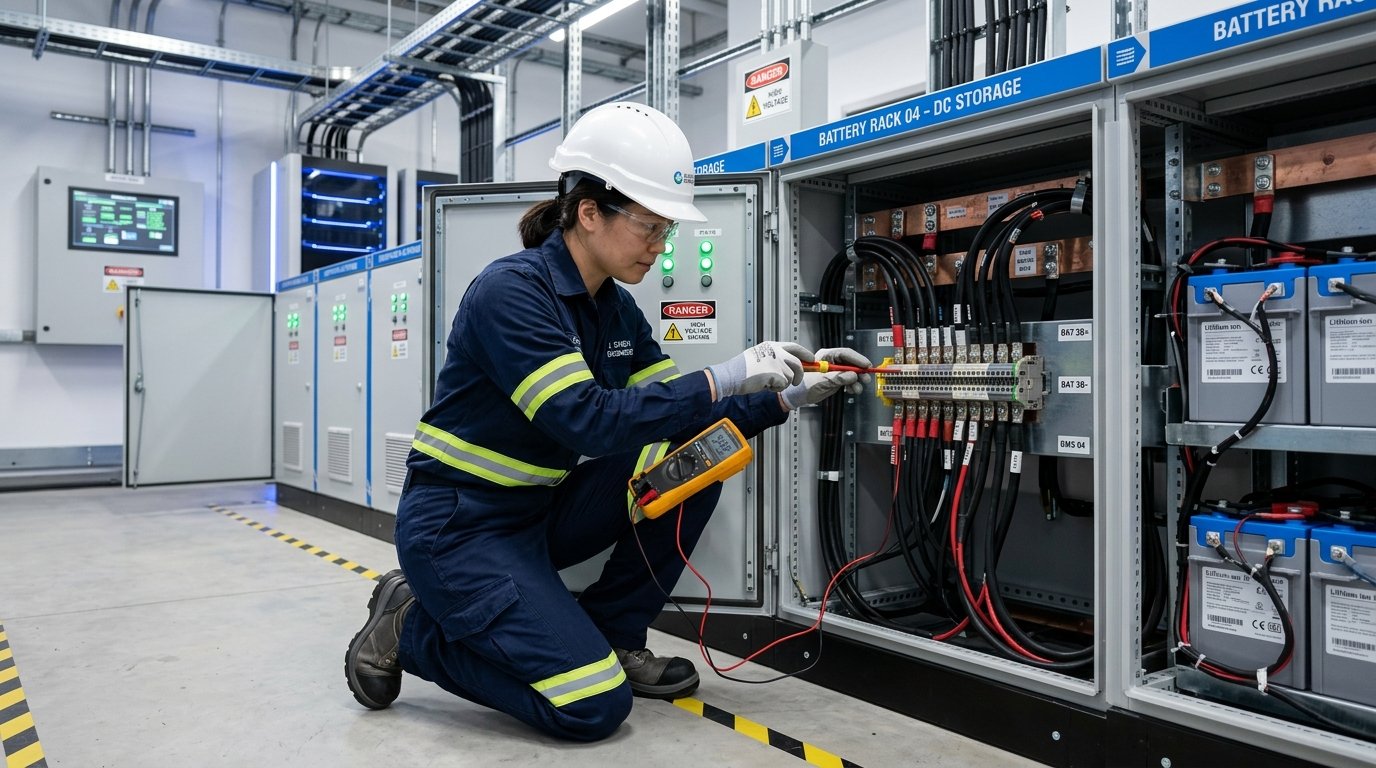
Where a residential VPP might coordinate tens of thousands of batteries under 15 kWh each, a C&I VPP might coordinate a few dozen sites, each with a battery energy storage system (BESS) ranging from a few hundred kilowatt hours up to several megawatt hours, alongside rooftop or ground mounted solar and, increasingly, some level of controllable load. That shift in scale changes the engineering approach fundamentally. Instead of statistical aggregation smoothing out the quirks of any individual residential battery, a C&I VPP has to engineer around the specific characteristics of each site, because the loss or underperformance of one large asset has a proportionally much bigger effect on the fleet’s aggregate capability than the loss of one home battery ever would in a residential program.
This also means C&I assets typically warrant a more bespoke commissioning and integration process. The power conversion system (PCS) specification, protection settings and communications architecture for a several megawatt hour commercial BESS are usually negotiated and engineered specifically for that site’s connection agreement with its distribution network service provider (DNSP), rather than deployed from a standardised residential product configuration.
On Site Load as Part of the Resource
The most distinctive feature of C&I VPP participation is that the site’s own load, not just its battery or solar generation, can be part of the tradable resource. A residential VPP is almost entirely about the battery. A commercial or industrial VPP can also treat controllable processes, refrigeration, pumping, certain manufacturing loads, HVAC (heating, ventilation and air conditioning) systems, or backup generation, as assets that can be curtailed or shifted in response to a market or network signal, alongside or instead of dispatching a battery.
Engineering this properly requires understanding which loads can actually be shed or shifted without compromising safety, product quality or contractual obligations, and building that understanding into the site’s control logic well before it is offered into any market or network program. This is fundamentally a site specific engineering exercise. It cannot be productised in the way a residential battery’s charge and discharge schedule can, because every industrial process has different constraints, and getting it wrong has operational consequences a household missing out on some arbitrage revenue simply does not have.
Demand Response Potential
Demand response, reducing or shifting load in response to a price or reliability signal, is a much bigger lever for C&I sites than for households, because the absolute load being managed is larger and often more flexible than a home’s day to day electricity use. This ranges from voluntary participation in retailer demand response programs through to more formal mechanisms such as AEMO’s Reliability and Emergency Reserve Trader (RERT), which is used as a last resort instrument to help maintain system reliability during periods of extreme stress, and which typically requires a genuinely reliable load reduction or standby generation capability rather than a best effort response.
The engineering task here is proving reliability. AEMO and program administrators need confidence that a committed demand response capability will actually materialise when called upon, which means the site’s control systems, its metering, and its operational procedures all need to support verifiable, repeatable load reduction, not just a theoretical estimate of what could be curtailed on a good day.
Network Tariff and Network Support Opportunities
C&I customers generally sit on more complex network tariff structures than residential customers, often involving demand charges based on a site’s peak import over a defined window, and increasingly involving flexible export and import limits negotiated directly with the DNSP. Network tariff structures for large business customers are also changing materially across most networks from July 2026, with increases varying by jurisdiction and by tariff class, which makes understanding a site’s specific tariff exposure a genuine engineering and commercial input into any BESS or VPP business case, not a background detail.
Beyond simple peak demand reduction, some networks are also actively procuring network support services from large flexible loads and behind the meter storage, effectively paying for capacity that helps defer network augmentation in a constrained part of the grid. Flexible connection arrangements, where a site accepts time varying import and export limits in exchange for different upfront connection costs and ongoing tariffs, are becoming more common as an alternative to a straightforward fixed capacity connection. Evaluating whether a site is a good candidate for these arrangements requires a proper load flow and connection study specific to that site’s network position, which is a materially more involved exercise than assessing a residential rooftop solar and battery installation.
Metering and Market Registration Complexity
Market registration for a C&I VPP participant is considerably more involved than enrolling a household battery in a retailer’s residential VPP plan. Depending on the site’s size and the market products being targeted, the business itself may need direct or indirect market registration considerations with AEMO, rather than simply being enrolled under an aggregator’s existing registration the way most residential customers are. Metering requirements are also more exacting, since revenue grade measurement typically needs to separately account for the site’s underlying load, its generation, and its battery dispatch, so that wholesale, FCAS (Frequency Control Ancillary Services) and any demand response settlement can all be reconciled correctly against what actually happened behind the meter.
This complexity is compounded when a site wants to participate in more than one program simultaneously, for instance stacking a network support arrangement with FCAS participation and wholesale arbitrage, because each program may have its own metering, telemetry and reporting requirements that need to coexist on the same underlying hardware and communications infrastructure without conflicting.
Risk, Governance and Site Specific Engineering
A household enrolling a battery in a VPP is typically taking on a modest, well bounded commercial risk. A commercial or industrial business considering VPP participation, particularly one that involves curtailing production processes or committing to a formal demand response obligation like RERT, is taking on operational risk that has to be governed properly. This usually means the engineering scope extends beyond the battery or the PCS into control system integration with the site’s existing building management or SCADA (supervisory control and data acquisition) systems, clear internal governance over who can authorise a load curtailment event, and contractual clarity over what happens if a committed response cannot be delivered on a given day.
None of this is a reason to avoid C&I VPP participation, since the network support, demand response and market revenue opportunities available to larger sites are genuinely more substantial per site than anything available to a single household. It is a reason to treat the engineering scoping exercise with the same rigour as any other significant capital or operational decision the business would make.
What to Do Next
C&I VPP participation touches network tariffs, market registration, control system integration and operational risk all at once, which is a wider scope than most internal energy teams handle day to day. This is the point where an independent technical review of the site’s connection, metering and control architecture can save considerable rework later, particularly if a network support or demand response commitment is being considered alongside a battery investment. We have helped commercial and industrial clients work through exactly this kind of scoping before committing to hardware or a program.
FAQ
How is a C&I VPP different from a residential VPP?
A C&I VPP typically coordinates a small number of large, individually engineered sites rather than a large statistical fleet of near identical home batteries, and can include on site load and demand response as tradable resources alongside battery storage.
Can a business’s own load be part of a VPP offer?
Yes, controllable processes such as refrigeration, pumping or HVAC can potentially be curtailed or shifted as part of a demand response or network support arrangement, though this requires site specific engineering to confirm what can safely be adjusted.
What is RERT and how does it relate to C&I demand response?
The Reliability and Emergency Reserve Trader is an AEMO mechanism used as a last resort to maintain system reliability during periods of extreme stress, typically requiring businesses to demonstrate a genuinely reliable load reduction or standby generation capability.
Do C&I sites face different network tariffs to households?
Yes, large business customers are typically on demand charge based tariffs and increasingly have access to flexible connection arrangements, and network tariff structures for large business customers are changing across most networks from July 2026.
Is market registration more complex for a C&I VPP participant?
Generally yes, since depending on the site’s size and the products being targeted, direct or indirect AEMO market registration considerations and separate revenue grade metering for load, generation and battery dispatch may be required, rather than simple enrolment under an aggregator’s existing registration.
What risks should a business consider before committing to demand response or VPP participation?
Operational risks around production continuity, product quality and contractual obligations need proper governance, including clear internal authority over curtailment decisions and contractual clarity on what happens if a committed response cannot be delivered.
