
By AGILE Consulting Engineers, Solar PV and Battery Energy Storage Systems (BESS) specialists.
The Waratah Super Battery in New South Wales, rated at 850 MW and 1,680 MWh, was reported by EnergyCo as nearing full capacity in September 2026, and analysts have flagged it as one of the most powerful grid batteries operating anywhere in the world. Numbers like that make for good headlines, but they hide the harder story: getting a battery energy storage system (BESS) from a paper concept to an energised asset in the National Electricity Market (NEM) involves years of engineering work that most of the public, and a fair few developers, never see.
Table of Contents
- What “Utility-Scale” Actually Means for a BESS
- Grid Connection and DNSP/TNSP Negotiation
- Site Selection and Civil Engineering Constraints
- Electrical Architecture and Protection Design
- Fire Risk and Thermal Management
- Control Systems and Market Participation
- Delivery Risk: Procurement, Staging and Commissioning
- What to Do Next
- FAQ
What “Utility-Scale” Actually Means for a BESS
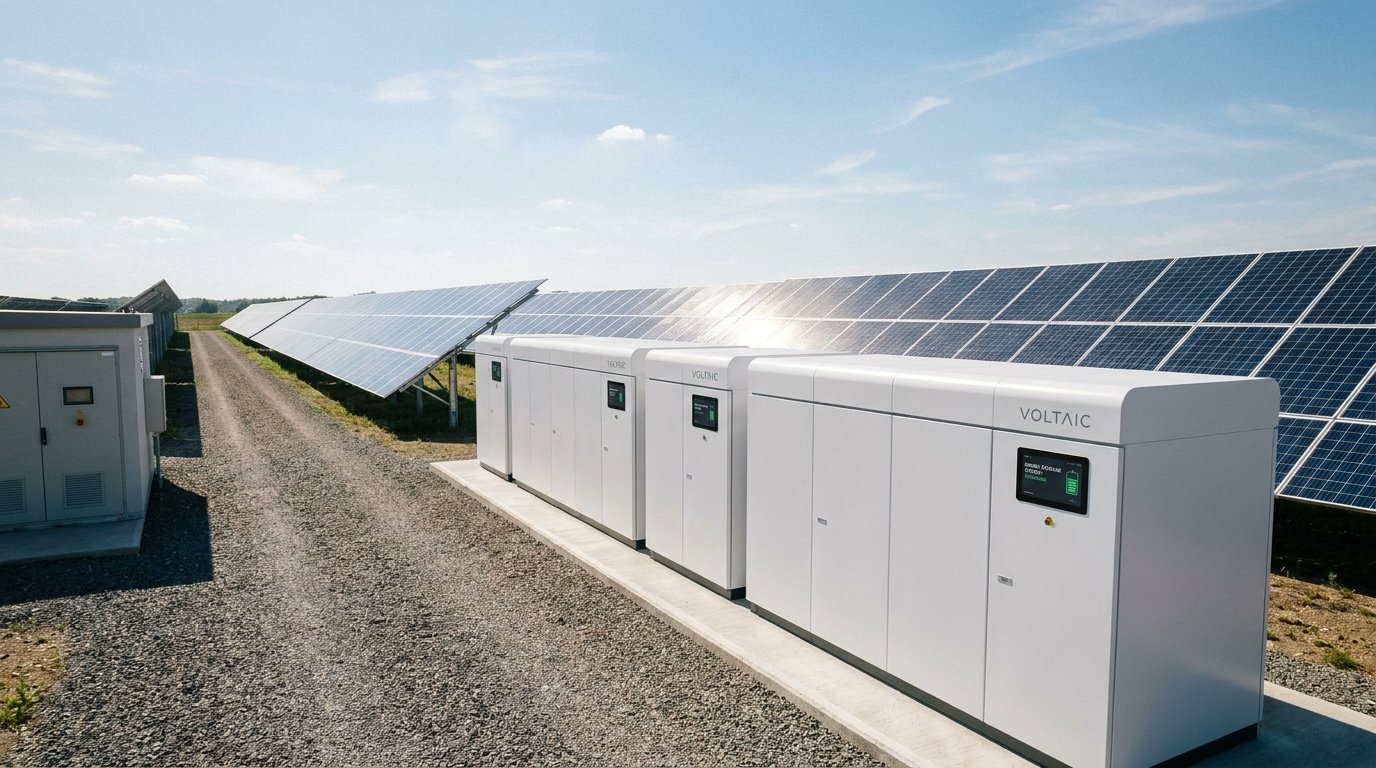
In the Australian context, a utility-scale BESS is generally a system connected at transmission or high-voltage distribution level, sized from tens of megawatts up to several hundred megawatts, and intended to provide services to the wider grid rather than a single site or business. These projects sit apart from commercial and industrial battery installations in almost every respect: the regulatory pathway, the number of engineering disciplines involved, the scale of civil and structural works, and the commercial exposure to the National Electricity Market (NEM) itself. A power conversion system (PCS), sometimes called a power conditioning system, converts the direct current (DC) from the battery racks into grid-compliant alternating current (AC), and at utility scale that conversion equipment is typically arranged in multiple blocks of several megawatts each, aggregated through a central substation.
Grid Connection and DNSP/TNSP Negotiation
Every utility-scale BESS in Australia has to negotiate a connection agreement with the relevant network business, whether that is a Distribution Network Service Provider (DNSP) or a Transmission Network Service Provider (TNSP), under the National Electricity Rules. This process sets out Generator Performance Standards covering voltage ride-through, frequency response, reactive power support and fault current contribution, and it is rarely a quick conversation. Network studies, power system modelling, and iterative negotiation with the network business can take longer than the physical construction itself, particularly on constrained parts of the grid where curtailment or augmentation becomes part of the discussion. Our guide to DNSP grid connection design requirements covers the documentation and technical studies this process typically demands in more detail.
Site Selection and Civil Engineering Constraints
Site selection for a large BESS is not just about land availability near a substation. Geotechnical conditions, flood risk, bushfire attack level, access for oversized transport (battery enclosures and transformers are heavy, awkward loads), and separation distances between battery blocks all feed into the civil design. Foundation type, whether piled, slab-on-grade, or a hybrid depending on soil bearing capacity, has direct cost and programme implications across a site that might host a hundred or more battery enclosures. These are genuinely site-specific decisions, and getting them wrong early tends to cascade into rework once electrical and fire engineering teams start applying their own constraints on top.
Electrical Architecture and Protection Design
The electrical architecture of a utility-scale BESS has to balance efficiency, redundancy and protection coordination across a system with many parallel DC sources. Single line diagrams for these projects typically show multiple battery blocks feeding through PCS units into a medium-voltage collector network, then stepping up through an onsite substation to the connection voltage. Protection design has to account for fault contribution from both the grid and the battery system itself, which behaves differently to a synchronous generator, and coordination studies need to reflect the actual short-circuit characteristics the inverters can supply. This is one area where documentation quality genuinely affects safety outcomes; our overview of single line diagrams for solar and BESS projects explains how these drawings underpin the rest of the design.
Fire Risk and Thermal Management
Battery fire risk has shaped Australian regulatory and insurance thinking since the 2021 fire at the Victorian Big Battery during commissioning testing, which prompted closer scrutiny of enclosure spacing, thermal management and emergency response planning across the industry. Utility-scale design now typically addresses fire risk through a combination of enclosure separation distances, gas detection and ventilation, and coordination with local fire authorities on emergency response plans, informed by the National Construction Code and jurisdiction-specific fire engineering requirements. Thermal management design, keeping cells within their optimal operating temperature band, also affects long-term degradation and warranty performance, so it is not purely a safety consideration.
Control Systems and Market Participation
An Energy Management System (EMS) coordinates the battery’s response to market signals, network constraints and any co-located generation, while a Supervisory Control and Data Acquisition (SCADA) system provides the visibility and remote control that AEMO and the network operator require. For a system intending to participate in Frequency Control Ancillary Services (FCAS), the control philosophy has to be designed around AEMO’s registration and bidding requirements from the outset, not retrofitted once construction is underway. Batteries have become a significant contributor to FCAS markets in the NEM in recent years, which has raised the commercial stakes attached to getting this control layer right.
Delivery Risk: Procurement, Staging and Commissioning
Utility-scale BESS projects also carry delivery risk that smaller systems rarely face at the same intensity: long lead times on transformers and switchgear, staged energisation across multiple battery blocks, and commissioning sequences that have to satisfy both the equipment manufacturer’s requirements and the network operator’s connection testing regime. A bill of quantities that accurately reflects long-lead items early in the design process gives a developer a realistic view of programme risk well before financial close, rather than discovering it during procurement.
What to Do Next
Utility-scale BESS projects reward early, disciplined engineering input, because the cost of a design change grows sharply once civil works or grid connection negotiations are underway. If you are assessing a site or preparing for a connection application, involving an experienced team through AGILE’s BESS engineering service at the concept stage tends to reduce the number of surprises later in the programme.
FAQ
What size does a BESS need to be before it is considered “utility-scale”?
There is no single regulatory threshold, but in practice utility-scale generally refers to systems connected at transmission or high-voltage distribution level, from tens of megawatts up to several hundred megawatts, distinguishing them from behind-the-meter commercial and industrial systems.
Why does grid connection take so long for large batteries?
The connection process under the National Electricity Rules involves detailed power system studies, negotiation of Generator Performance Standards, and iterative review by the network business, all of which can run in parallel with but often outlast the physical construction programme.
Is battery fire risk different from other electrical infrastructure?
Lithium-based battery fires behave differently to conventional electrical fires, including the potential for thermal runaway and reignition, which is why enclosure design, spacing and emergency response planning receive dedicated engineering attention on BESS projects.
Do utility-scale batteries always participate in FCAS markets?
Not necessarily. Some are contracted primarily for network support or a specific offtake arrangement, while others are designed and registered to participate across multiple NEM markets, including energy arbitrage and Frequency Control Ancillary Services.
What is the biggest engineering risk on a utility-scale BESS project?
Grid connection and civil siting risk tend to dominate early in a project’s life, while protection coordination and commissioning risk become more prominent once construction begins; both benefit from being addressed at concept and detailed design stage rather than left to the construction phase.
