By AGILE Consulting Engineers, Solar PV and Battery Energy Storage Systems (BESS) specialists.
Neither PVsyst nor HelioScope draws a single-line diagram, sizes a cable, or designs a foundation, and yet both tools sit right at the centre of how a solar project gets engineered. They exist to answer a narrower but critical question before any of that other design work is locked in: how much energy will this system actually produce, and where does shading or layout inefficiency eat into that number. Understanding what each tool does, and does not do, saves a lot of confusion about where the real engineering happens.
Table of Contents
- What Energy Yield Simulation Software Actually Does
- PVsyst: Detailed Physics-Based Simulation
- HelioScope: Cloud-Based Layout and Yield Modelling
- Key Differences Between the Two Tools
- Where These Tools Fit in the Detailed Design Workflow
- Other Software in the Design Stack
- Modelling Considerations Specific to BESS
- What to Do Next
- FAQ
What Energy Yield Simulation Software Actually Does
Energy yield simulation software models how much electricity a photovoltaic (PV) system will generate over time, accounting for the site’s solar resource, module and inverter characteristics, system losses and, critically, shading from nearby objects, terrain or the array’s own rows shading each other at low sun angles. The output is typically an expected annual and monthly energy yield figure, along with a detailed loss breakdown showing where energy is lost to temperature, soiling, wiring, inverter clipping, shading and other factors. This yield figure underpins the financial model for a project, which is why the credibility of the tool and the quality of the inputs used both matter enormously to financiers.
These tools sit early and also recur throughout the design process. A yield simulation is run at feasibility stage on assumed inputs, refined at preliminary design once layout and equipment selections firm up, and finalised during detailed design once the actual site layout, module and inverter selections and site-specific shading obstructions are locked in. The final yield report is typically one of the documents a financier’s independent engineer specifically reviews as part of due diligence.
PVsyst: Detailed Physics-Based Simulation
PVsyst is a desktop-based simulation tool that has been the long-standing reference standard for bankable solar yield reports globally, largely because of its detailed, physics-based, hour-by-hour simulation approach and its comprehensive loss modelling. It models near shading using array-level geometry and a shading factor approach that requires a degree of expertise to configure correctly, and it handles complex system configurations, including large utility-scale arrays with multiple sub-arrays and varied equipment, well.
Because of its long track record, PVsyst reports are widely accepted by project finance lenders without the report itself being questioned, provided it has been configured competently. That reputation is also PVsyst’s main practical drawback: its interface is dense and its shading methodology has a real learning curve, so the quality of a PVsyst report depends heavily on the experience of the person configuring it, not just on the software itself.
HelioScope: Cloud-Based Layout and Yield Modelling
HelioScope is a cloud-based design and simulation platform that combines system layout design with energy yield modelling in a more visual, browser-based workflow. Its shading analysis uses geolocated three-dimensional shading profiles with yearly visual maps, which tends to be more intuitive to interpret than PVsyst’s shading factor approach, and its layout tools make it efficient for iterating quickly on module placement, especially for commercial and industrial scale projects. Independent validation work has found HelioScope’s yield calculations track closely with PVsyst when the same underlying assumptions are used, and HelioScope has been gaining bankability recognition from an increasing number of financiers for commercial-scale projects.
Where HelioScope tends to be favoured is in projects where fast iteration on layout matters as much as the final yield number, given its modern interface and browser-based collaboration. Where PVsyst tends to be favoured is on larger, more complex utility-scale projects and wherever a financier specifically expects a PVsyst report as part of their standard due diligence process.
Key Differences Between the Two Tools
The practical differences between the two tools come down to a handful of factors that matter for how a project team chooses between them.
- Deployment: PVsyst is desktop-based software with a steeper interface, while HelioScope runs in a browser with a more modern, collaborative workflow.
- Shading methodology: PVsyst uses a near-shading factor approach requiring configuration expertise, while HelioScope produces geolocated three-dimensional shading profiles that are generally more visually intuitive.
- Scale and complexity: PVsyst is generally preferred for large, complex utility-scale systems, while HelioScope is widely used for commercial and industrial scale projects where rapid layout iteration is valuable.
- Bankability recognition: PVsyst has the longer, broader track record with project finance lenders, while HelioScope’s acceptance has been growing, particularly in the commercial and industrial segment.
Neither tool is categorically “better.” The right choice depends on project scale, the specific financier’s expectations, and the design team’s workflow preferences, and it is common for engineering teams to be proficient in both and select based on the project at hand.
Where These Tools Fit in the Detailed Design Workflow
It is worth being clear about what these tools are not. They are not electrical design software, and they do not replace the single line diagram, cable schedule, protection design or structural drawings that make up the rest of a detailed design package. Their role is to establish and validate the energy performance case for the layout, module and inverter selections that the rest of the detailed design then documents and constructs around. A finalised PVsyst or HelioScope report, once locked in against the actual detailed design layout, becomes one of the reference documents that the electrical and structural teams design against, since it confirms the equipment quantities and system configuration the rest of the package needs to be consistent with.
The electrical drawings, structural drawings and civil design work described elsewhere in AGILE’s detailed design content sit alongside, not inside, the yield simulation. A common mistake among less experienced project teams is treating a polished PVsyst or HelioScope report as equivalent to a complete engineering package. It is a critical input, not a substitute for the rest of detailed design.
Other Software in the Design Stack
Alongside yield simulation tools, a typical detailed design workflow uses computer-aided design (CAD) and building information modelling (BIM) software, commonly AutoCAD or Revit, to produce the actual electrical, structural and civil construction drawings, general arrangements and site layouts. Structural analysis software is used separately to verify racking and foundation designs against wind loading and geotechnical inputs. These tools serve a different purpose to PVsyst or HelioScope: where the yield simulation tools answer “how much energy will this produce,” the CAD and structural tools answer “exactly how does this get built.” A competent detailed design process moves data between these tool categories deliberately, rather than treating them as disconnected exercises.
Modelling Considerations Specific to BESS
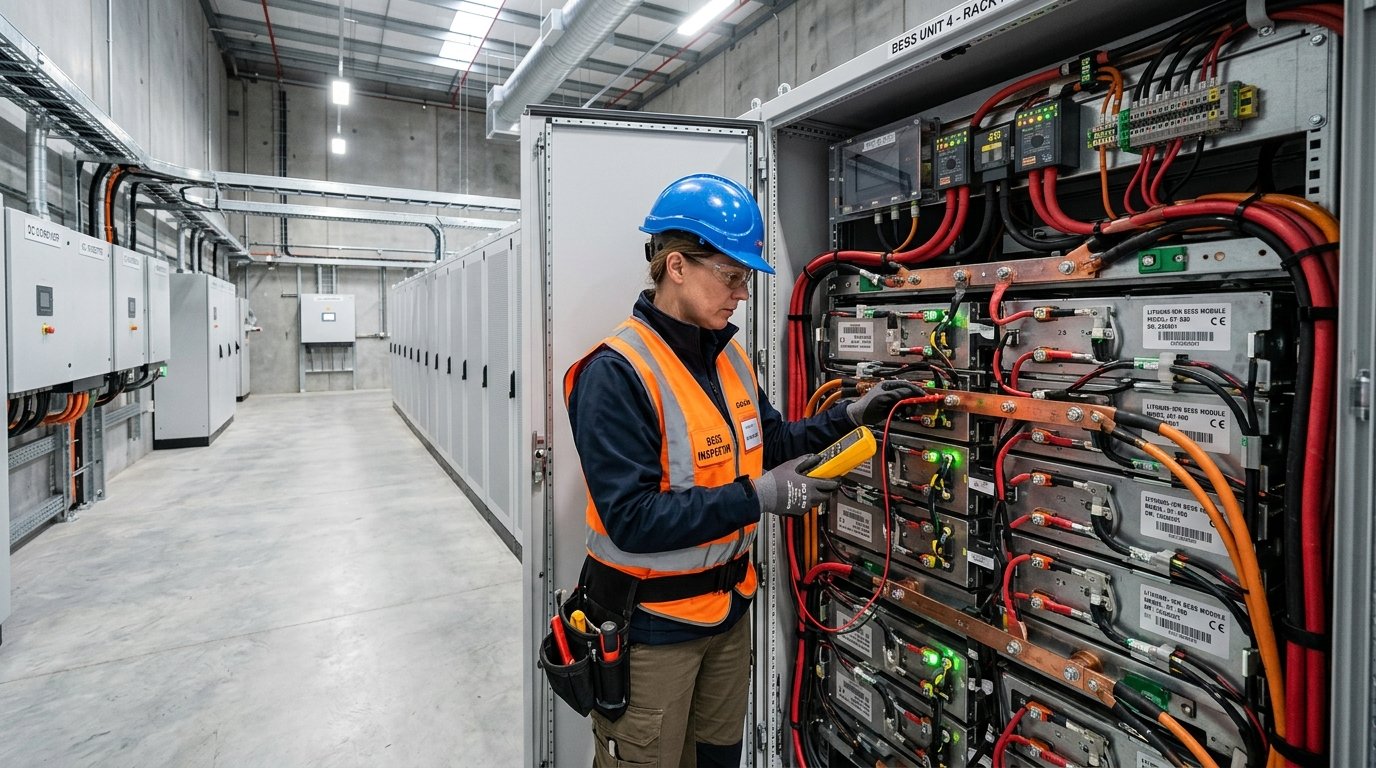
Battery energy storage system (BESS) modelling sits somewhat apart from PVsyst and HelioScope, which are primarily built around PV generation and shading. Where a project includes a co-located or hybrid solar and BESS system, battery dispatch and state-of-charge behaviour is typically modelled using separate tools or methodologies tailored to the specific market participation strategy, whether that is firming solar output, arbitrage, or providing frequency control ancillary services into the National Electricity Market (NEM), the wholesale market operated by the Australian Energy Market Operator (AEMO). PVsyst does have some capability to model DC-coupled PV-battery configurations, but BESS-specific dispatch and revenue modelling generally sits in dedicated tools or bespoke analysis rather than inside a PV yield simulation package.
What to Do Next
If you are trying to work out which yield simulation approach is right for your project, or you want the yield modelling properly reconciled against the rest of a detailed design package rather than treated as a standalone report, that reconciliation is exactly the kind of work worth getting right early. AGILE Consulting Engineers works across both PVsyst and HelioScope as part of a coordinated detailed design process for Australian solar and BESS projects, and AGILE’s solar and BESS system design service is a good place to start that conversation.
FAQ
Is PVsyst or HelioScope more accurate for energy yield prediction?
Independent validation work has found the two tools’ yield calculations track closely when the same underlying assumptions are used, so accuracy in practice depends more on input quality and configuration expertise than on which tool is chosen.
Which tool is better for utility-scale solar projects?
PVsyst is generally preferred for large, complex utility-scale systems and where financiers specifically expect a PVsyst report, given its long track record and detailed physics-based loss modelling.
Do PVsyst and HelioScope design the electrical or structural systems?
No. Both tools focus on energy yield and shading analysis, not electrical or structural design, which are handled separately through the single line diagram, cable schedules, protection design and structural drawings produced during detailed design.
Is HelioScope accepted by lenders for project finance?
HelioScope’s bankability recognition has been growing, particularly for commercial and industrial scale projects, though PVsyst retains the broader, longer-standing track record across project finance more generally.
Can these tools model battery energy storage system performance?
PVsyst has some capability for modelling DC-coupled PV-battery configurations, but BESS-specific dispatch and revenue modelling generally requires separate tools or bespoke analysis tailored to the project’s market participation strategy.
Do detailed design teams need both PVsyst and HelioScope?
Not necessarily, but many experienced design teams maintain proficiency in both and choose based on project scale, financier expectations and workflow needs rather than committing to a single tool for every project.
