
By AGILE Consulting Engineers, Solar PV and Battery Energy Storage Systems (BESS) specialists.
A battery energy storage system (BESS) engineer is not simply an electrical engineer who happens to work on batteries. The role sits across power systems engineering, controls, civil and structural coordination, and regulatory process, and it is the discipline most responsible for the gap between a developer’s spreadsheet model and a battery that actually performs as promised once it is energised. As storage has become a standard companion to solar and wind generation in Australia rather than a novelty, the scope of this role has grown accordingly.
Table of Contents
- Defining the BESS Engineer’s Role
- Feasibility and Concept Design
- Detailed Design
- The Owner’s Engineer Function
- Interdisciplinary Coordination
- Interface With Regulators and Network Operators
- Commissioning and Handover
- What to Do Next
- FAQ
Defining the BESS Engineer’s Role
In practice, “BESS engineer” describes a function rather than a single job title. It can mean the lead electrical engineer producing single line diagrams and protection studies, the systems engineer responsible for the control philosophy, or the independent professional acting as owner’s engineer on behalf of a developer or financier. What ties these roles together is a working command of how the battery, the power conversion system (PCS), the energy management system (EMS), and the grid connection interact as one integrated system rather than as separate pieces of equipment bolted together.
Feasibility and Concept Design
Early in a project, a BESS engineer’s contribution is often about testing whether a proposed site and configuration is actually viable before significant capital is committed. This includes preliminary sizing against the intended use case, an initial view of grid connection feasibility with the local network business, and flagging site constraints, geotechnical, planning, or bushfire-related, that could materially affect cost or programme. This early-stage work is deliberately lighter-touch than what follows, setting direction rather than producing construction-ready drawings.
Detailed Design
Once a project proceeds, detailed design translates the concept into the drawings, specifications and calculations that a contractor can actually build from: single line diagrams, protection coordination studies, civil and structural drawings for battery enclosures and foundations, a control philosophy document, and a bill of quantities that reflects long-lead equipment realistically. This is typically the largest single body of work a BESS engineer performs on a project, and the quality of it has a direct bearing on construction risk, since errors caught on paper are dramatically cheaper to fix than errors caught on site. Our explainer on what detailed design involves for solar and BESS projects sets out the scope of this phase in more detail.
The Owner’s Engineer Function
On projects delivered by an EPC (engineering, procurement and construction) contractor, a BESS engineer is often engaged separately by the asset owner or financier as an owner’s engineer, providing independent review of the contractor’s design, monitoring construction quality, and verifying that commissioning results actually meet the contracted performance guarantees. This function exists precisely because the EPC contractor’s incentives and the owner’s incentives are not always perfectly aligned, particularly around cost and programme pressure late in a project. Our overview of owner’s engineer services for battery storage projects covers this function in more depth.
Interdisciplinary Coordination
A BESS is not a purely electrical asset. Civil engineers determine foundation type and site drainage; structural engineers size enclosure supports and confirm wind and seismic loading; fire engineers assess separation distances and emergency response requirements; and controls engineers design how the EMS and Supervisory Control and Data Acquisition (SCADA) systems will actually operate the asset day to day. The BESS engineer’s coordination role is to make sure these disciplines are working from a consistent set of assumptions, chemistry, sizing, duty cycle, so that a decision made in one discipline does not quietly invalidate work already completed in another.
Interface With Regulators and Network Operators
A significant part of the role involves translating regulatory and network requirements into design inputs the rest of the team can work with. This means engaging with the relevant Distribution Network Service Provider (DNSP) or Transmission Network Service Provider (TNSP) on connection studies, working through the Australian Energy Market Operator’s (AEMO) requirements for larger systems intending to participate in the National Electricity Market (NEM), and ensuring the design satisfies the applicable Australian and joint Australian/New Zealand Standards. This is rarely a one-off task; it typically runs in parallel with design development and can materially affect the final system configuration.
Commissioning and Handover
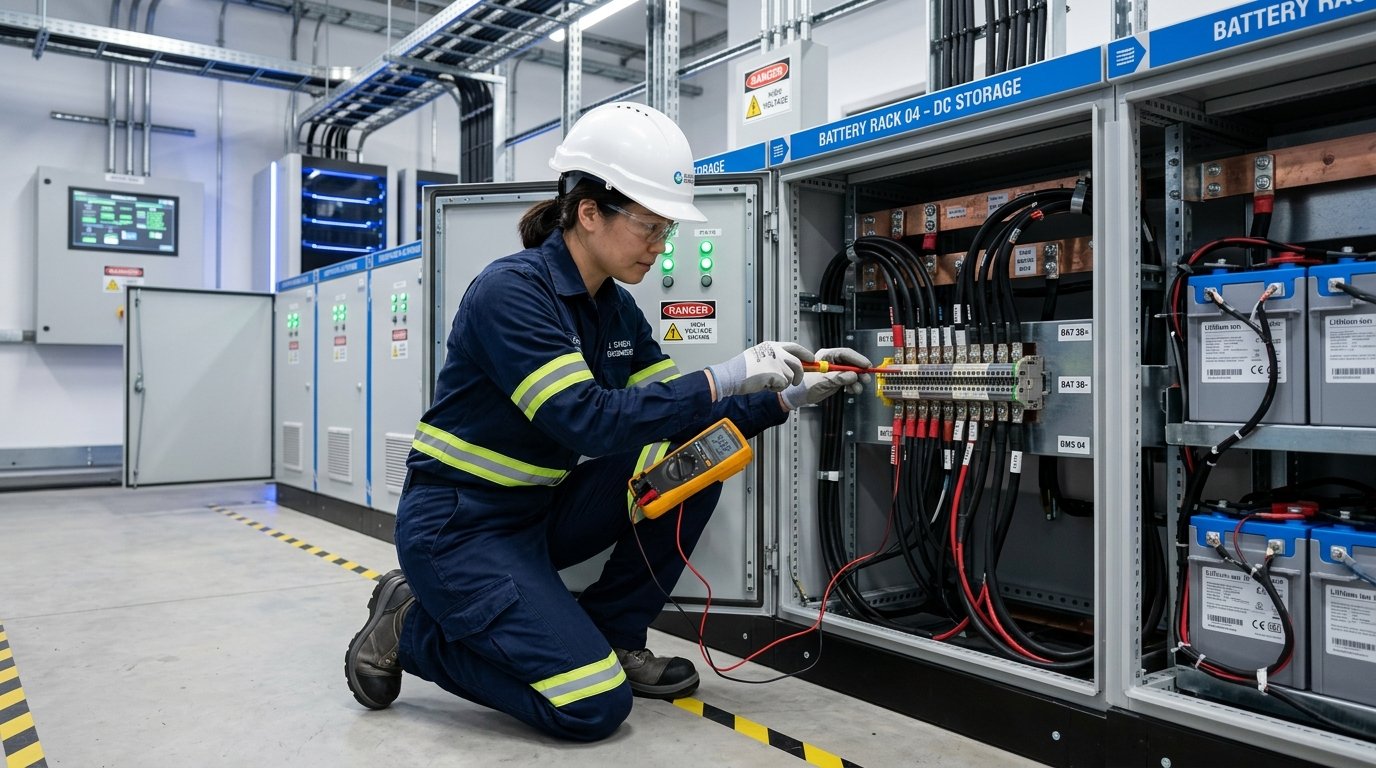
The BESS engineer’s involvement does not end when construction finishes. Commissioning testing needs to be verified against the design intent and any contracted performance guarantees, and handover documentation, as-built drawings, operation and maintenance manuals, and control system documentation, needs to give the operator what they actually need to run the asset safely for its operating life. Projects that treat commissioning as a formality rather than a verification step tend to be the ones that discover performance shortfalls only after the warranty period has started running.
What to Do Next
Whether you need concept-stage feasibility input, full detailed design, or independent oversight of a contractor’s delivery, the value of a BESS engineer comes from continuity across these phases rather than a single isolated deliverable. AGILE’s BESS engineering service supports renewable energy projects across this full lifecycle, from early feasibility through to commissioning.
FAQ
Is a BESS engineer the same as a solar PV engineer?
There is significant overlap, since many BESS projects are co-located with solar generation, but BESS engineering also draws on battery-specific knowledge, chemistry behaviour, degradation modelling, thermal and fire engineering, and control philosophy design, that a solar-only engineer may not routinely work with.
When should a BESS engineer be engaged on a project?
Ideally at the feasibility stage, before a site or configuration is locked in, since early input on grid connection feasibility and site constraints tends to prevent costly redesign later in the project.
What is the difference between a BESS engineer working for an EPC contractor and one acting as owner’s engineer?
An engineer working for the EPC contractor is delivering the design and construction, while an owner’s engineer is engaged independently by the asset owner or financier to review that work and verify it meets the contracted requirements.
Does a BESS engineer need to understand grid regulations as well as electrical design?
Yes. Grid connection and market participation requirements set by the network operator and AEMO directly shape technical design decisions, so a BESS engineer needs working knowledge of both the engineering and regulatory sides of a project.
What happens if commissioning issues are found after a BESS is energised?
Depending on the issue, it may require rework, a warranty claim against equipment suppliers, or a negotiated resolution with the EPC contractor, all of which are generally more costly and disruptive than issues identified and corrected during design or commissioning testing.
