
By AGILE Consulting Engineers, Solar PV and Battery Energy Storage Systems (BESS) specialists.
Commercial and industrial (C&I) sites rarely install a battery energy storage system (BESS) for a single reason. A cold storage facility might want peak demand reduction and backup resilience in the same system; a manufacturing site might be chasing frequency control ancillary services (FCAS) revenue on top of solar self-consumption. Every additional use case stacked onto a C&I battery adds engineering complexity, and the sites that get the most value from their BESS are usually the ones where that complexity was worked through in the design phase, not discovered after commissioning.
Table of Contents
- Defining the Use Case Before the Equipment
- Load Profile Analysis and System Sizing
- Integration With Existing Electrical Infrastructure
- Control Philosophy and Energy Management
- Grid Connection Considerations for C&I Sites
- Site Constraints: Space, Access and Fire Safety
- Commercial and Operational Factors That Feed Back Into Design
- What to Do Next
- FAQ
Defining the Use Case Before the Equipment
The starting point for any C&I battery project should be a clear statement of what the system needs to do, not a battery capacity in kilowatt-hours. Peak demand reduction, solar export management, backup power for critical loads, and participation in a virtual power plant (VPP) or FCAS market each place different demands on the power conversion system (PCS), the battery management system (BMS) and the control architecture. A system designed primarily for backup resilience, for instance, needs to prioritise state of charge reserves and seamless transfer switching, which can directly conflict with a design optimised purely for maximising demand charge savings. Resolving these priorities before equipment selection avoids a system that’s technically capable but poorly matched to what the business actually needs from it.
Load Profile Analysis and System Sizing
Sizing a C&I BESS properly requires interval data, not an average monthly bill. Half-hourly or sub-hourly load data reveals the shape and frequency of demand peaks, which is what actually determines how much power and energy capacity is needed to meaningfully reduce a demand charge or ride through an outage. Oversizing wastes capital, while undersizing means the system fails to deliver the savings or resilience it was justified on. For sites with existing or planned solar generation, the interaction between solar output, battery charging and site load also needs to be modelled together rather than as separate systems, since the economics of a combined solar-plus-storage system depend heavily on how well the battery’s charge and discharge behaviour is matched to the site’s actual solar generation profile and consumption pattern.
Integration With Existing Electrical Infrastructure
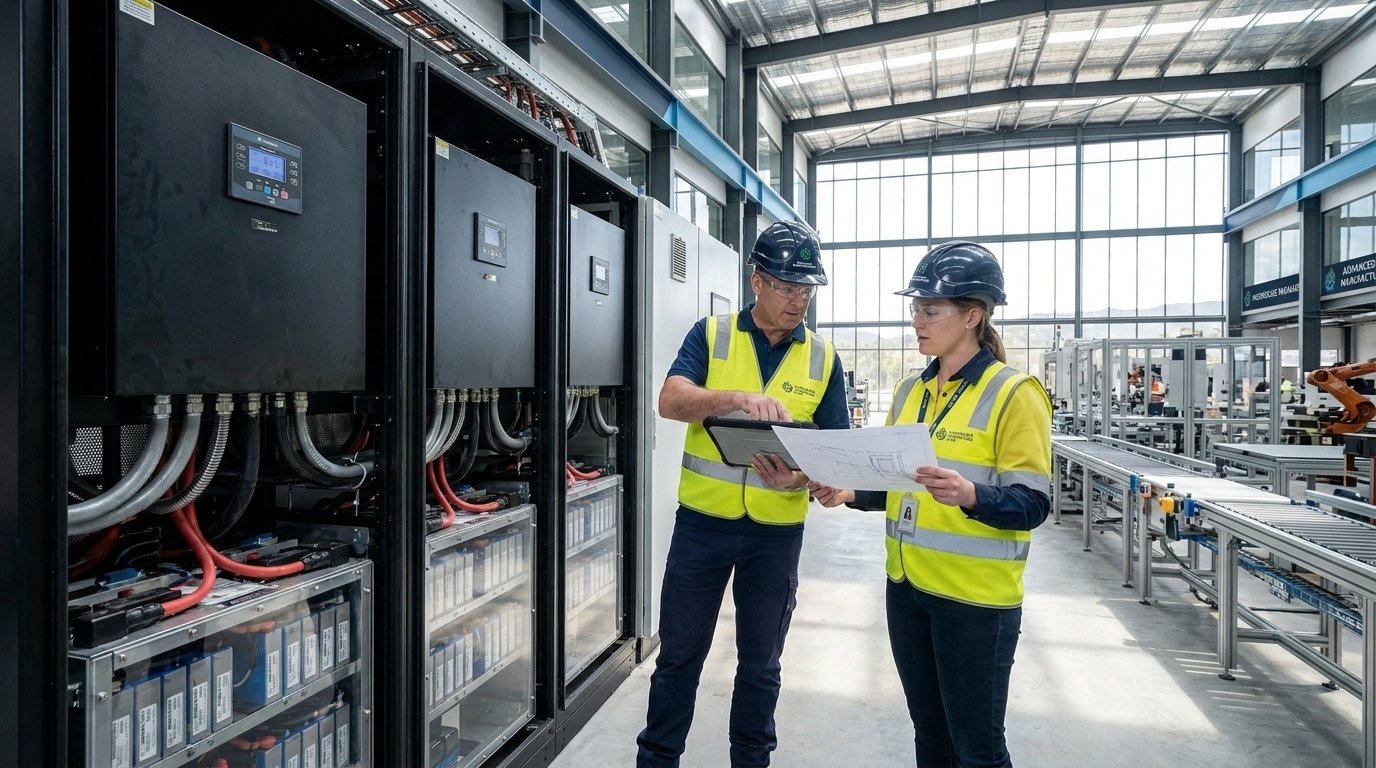
Retrofitting a BESS into an operating commercial or industrial site means working within the constraints of existing switchboard capacity, fault levels and protection coordination, which is often more involved than designing a system into a greenfield site. Existing switchboards may need upgrading to accommodate the additional fault current contribution or to provide adequate circuit protection for the new equipment, and cable route and thermal capacity constraints can materially affect where equipment can practically be located. AGILE’s guide to single line diagrams for solar and BESS projects is a useful reference for understanding how these integration points get documented and reviewed, since the single line diagram is usually where conflicts between new and existing infrastructure first become visible.
Control Philosophy and Energy Management
An energy management system (EMS) coordinating multiple use cases needs a clearly defined hierarchy of priorities, because demand reduction, backup readiness, and market participation can pull the battery’s charge and discharge schedule in different directions at the same time. If the control philosophy doesn’t explicitly resolve these conflicts, the system defaults to whatever behaviour the EMS vendor’s software happens to prioritise, which may not match the site’s actual commercial objectives. This is a design decision, not just a software configuration task, and it needs to be worked through with the same rigour as the electrical design itself.
Grid Connection Considerations for C&I Sites
C&I batteries connect under the same distribution network service provider (DNSP) framework as any other embedded generation or storage system, and the specific requirements depend on system size, export capability and whether the site sits in a constrained part of the network. AGILE’s article on DNSP grid connection design requirements for solar and BESS systems covers this in more detail, and for C&I sites specifically, export and import limits, interval metering arrangements and interface protection requirements all need to be confirmed with the relevant DNSP early, since they can materially affect both system sizing and the achievable business case.
Site Constraints: Space, Access and Fire Safety
Many C&I sites weren’t designed with battery storage in mind, which means available space, structural capacity for rooftop or elevated installations, and vehicle access for maintenance and emergency response all need to be assessed as part of the engineering process rather than assumed. Fire safety separation requirements, covered by standards such as AS/NZS 5139 for battery installation safety, can constrain where equipment is practically sited relative to buildings, boundaries and other plant, particularly on space-constrained industrial sites. Working through these constraints early, alongside the electrical design, generally avoids the scenario where a preferred equipment location turns out to be non-compliant once a fire safety or civil assessment is completed.
Commercial and Operational Factors That Feed Back Into Design
Tariff structure, any existing power purchase or retail agreement, and the site’s appetite for participating in demand response or VPP programmes all feed back into technical design decisions, not just the business case. A site on a demand-based tariff structure needs different control logic to one exposed to volatile wholesale pricing, and a business considering future VPP participation benefits from equipment and communications architecture that can support that from the outset, rather than requiring retrofit later. Engaging operations and finance stakeholders during design, not just after a proposal is finalised, tends to produce a system that’s actually operated the way it was designed to be used.
What to Do Next
C&I battery projects succeed or struggle largely on how well the use case, site constraints and control philosophy are reconciled before construction starts. Working through that reconciliation with an engineering partner familiar with commercial and industrial sites specifically is a core part of AGILE’s BESS engineering service, and it’s worth involving that expertise before equipment is selected rather than after.
FAQ
What’s the biggest engineering difference between a residential and a C&I battery system?
Scale and use case complexity. C&I systems more often stack multiple objectives, demand reduction, backup, FCAS participation, which requires a more deliberate control philosophy and typically involves integration with existing switchboards and protection systems rather than a simpler standalone installation.
How is a C&I battery sized correctly?
Sizing should be based on interval load data, ideally half-hourly or finer, rather than average monthly consumption, because the shape and frequency of demand peaks is what actually determines the power and energy capacity needed to deliver the intended outcome, whether that’s demand charge reduction or backup resilience.
Can an existing switchboard usually accommodate a new BESS?
It depends on the existing installation. Fault level contribution, available circuit protection capacity and physical space all need to be assessed, and many retrofit projects require switchboard upgrades to accommodate the new equipment safely and in compliance with relevant standards.
Do C&I batteries need to support multiple revenue streams to be worthwhile?
No. A single clear use case, such as demand charge reduction, can justify a BESS on its own. Stacking additional use cases can improve the business case but adds control and engineering complexity that needs to be properly resolved in the design.
What role does fire safety play in siting a C&I battery system?
Fire safety separation requirements, informed by standards such as AS/NZS 5139 and, for larger systems, dedicated fire safety studies, can significantly constrain where equipment can practically be located relative to buildings, boundaries and other site infrastructure, particularly on constrained industrial sites.
Should operations and finance teams be involved in the technical design process?
Generally yes. Tariff structure, existing energy contracts and future plans for demand response or VPP participation all influence control logic and equipment selection, so early input from operational and commercial stakeholders tends to produce a system that better matches how the business actually intends to use it.
