By AGILE Consulting Engineers, Solar PV and Battery Energy Storage Systems (BESS) specialists.
Calling grid scale and commercial and industrial (C&I) battery projects “the same technology at different sizes” undersells how differently they actually get engineered. By early 2026, AEMO reported data tracked by industry analysts put the National Electricity Market’s (NEM) registered utility scale battery fleet at more than 7 gigawatts of capacity, and that fleet was engineered to a fundamentally different set of requirements than the behind the meter systems now common on commercial rooftops and industrial sites.
Table of Contents
- Two Different Engineering Problems
- Scale and Connection Voltage
- Regulatory Pathway: DNSP Versus AEMO and the NER
- Purpose and Control Philosophy
- Civil and Structural Considerations
- Protection and System Strength
- Commercial and Contractual Differences
- What to Do Next
- FAQ
Two Different Engineering Problems
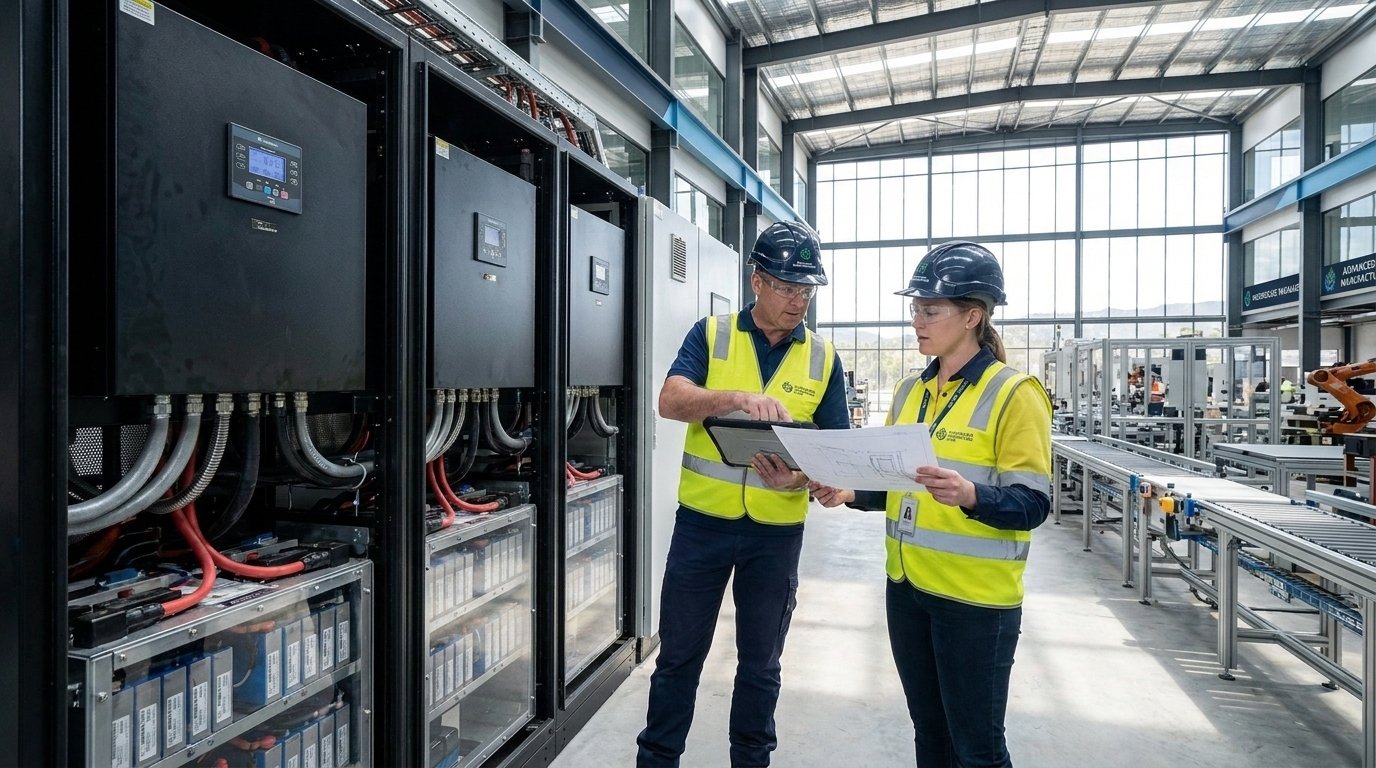
A grid scale BESS is typically a standalone generating asset, connected directly to the transmission or subtransmission network and participating in the NEM as a market generator, dispatched by the Australian Energy Market Operator (AEMO). A commercial and industrial BESS is usually a behind the meter asset sitting on a customer’s own site, sized to manage that customer’s load rather than to trade energy at scale. The two share battery chemistry and basic power electronics, but the engineering problem each one solves is different enough that the design approach, connection process, and even the standards applied diverge substantially.
Scale and Connection Voltage
Grid scale systems commonly run from tens of megawatt hours into the hundreds, connecting at high voltage through a dedicated substation built as part of the project. C&I systems are usually smaller, from under a megawatt hour up to a few tens of megawatt hours, and connect at low or sometimes high voltage directly into a site’s existing electrical infrastructure. That difference in connection voltage alone changes the switchgear, protection, and civil requirements considerably, a dedicated HV substation is a different order of engineering problem to a switchboard upgrade on an existing industrial site. It also changes the design programme, since procuring and commissioning a new substation typically takes far longer than integrating a battery into infrastructure that already exists and is already energised.
Regulatory Pathway: DNSP Versus AEMO and the NER
Most C&I BESS projects connect through their local Distribution Network Service Provider’s (DNSP) standard connection process, which scales in complexity with system size but generally follows established, well trodden technical submission requirements. Grid scale projects, particularly anything connecting at transmission level or large enough to influence network stability, move through a more involved process governed by the National Electricity Rules (NER), including negotiation of generator performance standards directly with AEMO. This pathway typically requires detailed system strength and dynamic modelling studies that most C&I projects never need to undertake. Our guide to detailed design for ground mount utility scale projects covers what that heavier process involves in practice.
Purpose and Control Philosophy
A grid scale BESS is generally controlled to respond to market signals, dispatch instructions, and Frequency Control Ancillary Services (FCAS) participation, with an Energy Management System (EMS) that optimises around wholesale price and network conditions. A C&I system is more commonly controlled around a customer’s own load profile, targeting peak demand reduction, tariff optimisation, or backup power resilience, sometimes alongside participation in a Virtual Power Plant (VPP) aggregation. The control logic, and therefore the EMS configuration and the data the system needs to make decisions, reflects these different objectives from the ground up rather than being a scaled version of the same thing.
Civil and Structural Considerations
Grid scale projects are usually greenfield sites, giving the design team freedom to lay out battery enclosures, transformers, and switchgear for optimal cable runs and maintenance access, but requiring full geotechnical investigation and foundation design from scratch. C&I projects frequently retrofit into existing sites, constrained by available space, existing structures, and sometimes rooftop loading limits for building integrated systems. Our article on rooftop solar and BESS detailed design for commercial buildings looks at the specific constraints that come with fitting a battery system into an existing commercial building rather than a purpose built site.
Protection and System Strength
Grid scale batteries have to be engineered with an awareness of network wide system strength, their protection settings and control response need to remain stable across a range of fault conditions that could occur anywhere nearby on the network, not just at their own connection point. C&I systems are generally more self contained from a protection standpoint, focused on coordinating with the site’s existing switchboard and the DNSP’s local network protection rather than broader system stability. This difference in scope is a large part of why grid scale connection studies take considerably longer and involve more specialised modelling.
Commercial and Contractual Differences
Grid scale projects typically involve project financing, long term offtake or market participation arrangements, and Engineering, Procurement and Construction (EPC) contracts structured around performance guarantees tied to market revenue. C&I projects are more often financed against a single customer’s energy bill savings, with simpler contractual structures and shorter delivery timelines. These commercial differences feed back into engineering decisions too, a grid scale project’s design has to support the performance testing and reporting that financiers and offtake counterparties require, which is rarely a factor on a single site C&I installation. Design documentation for a grid scale asset is also generally held to a higher standard of independent verification, since lenders will often require their own technical advisor to review the engineering before funds are released.
What to Do Next
Whether your project sits at grid scale or behind a commercial meter, the engineering approach needs to match that context from the start rather than being adapted partway through. AGILE’s BESS engineering service covers both ends of this spectrum, tailoring the design, connection strategy, and documentation to the scale and purpose of the specific project.
FAQ
Is grid scale BESS engineering simply a bigger version of C&I engineering?
No. The regulatory pathway, control objectives, and system strength considerations differ substantially, not just the physical size of the equipment involved.
Can a C&I BESS participate in the wholesale electricity market?
Some can, typically through aggregation into a VPP or via a retailer or aggregator arrangement, but this is different from the direct market participation of a standalone grid scale asset dispatched by AEMO.
Why do grid scale projects need system strength studies and C&I projects usually do not?
System strength studies assess how a large generating asset affects stability across the surrounding network. Smaller C&I systems generally have a much smaller network impact, so DNSP connection processes assess them at a more localised level.
Do both grid scale and C&I BESS need to comply with the same battery safety standard?
Both are subject to the relevant Australian and New Zealand battery safety standard for the battery system itself, though grid scale projects typically layer additional high voltage and switchgear standards on top given their scale.
Which type of BESS project generally has a shorter delivery timeline?
C&I projects are usually faster to deliver, largely because their connection process and financing arrangements are less complex than the market participation and system strength studies a grid scale project typically requires.
