
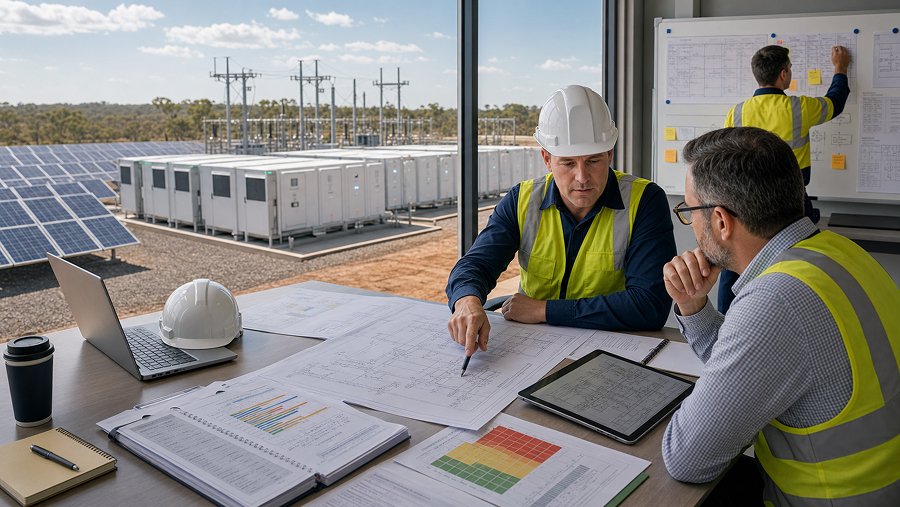
Virtual Power Plants (VPPs) are quietly reshaping how electricity grids are balanced, traded, and stabilized. Instead of relying on a single large generating station, a VPP stitches together thousands of small, distributed energy resources—rooftop solar, home batteries, EV chargers, smart thermostats, and commercial generators—into one coordinated, controllable fleet. To the grid operator, it behaves like a single power plant. To the engineer, it is one of the most demanding systems-integration challenges in modern energy.
This article walks through what VPP engineering actually involves, from the earliest system design decisions to the final hurdle of grid integration and compliance.
Table of Contents
- What Is a Virtual Power Plant?
- System Design Fundamentals
- Communication and Data Layers
- Optimization and Control Logic
- Grid Integration and Compliance
- The Road Ahead
What Is a Virtual Power Plant?
A Virtual Power Plant is a cloud-based aggregation of decentralized energy assets, orchestrated by software to deliver services traditionally provided by conventional power stations. These services include energy supply during peak demand, frequency regulation, voltage support, and reserve capacity.
The “virtual” part is key: no new physical plant is built. The value comes from coordination. A single home battery is trivial to the grid, but ten thousand of them, dispatched in unison, can deliver tens of megawatts of flexible capacity on demand. VPP engineering is the discipline of making that coordination reliable, fast, safe, and economically worthwhile.
System Design Fundamentals
Good VPP engineering begins long before any asset is switched on. The design phase determines whether the platform can scale from a pilot of a few hundred devices to a commercial fleet of hundreds of thousands.
Distributed Energy Resource Selection
Not all distributed energy resources (DERs) contribute equally. Engineers classify assets by their response characteristics: how quickly they can ramp, how long they can sustain output, and how predictable they are. Batteries offer near-instantaneous, high-precision response, making them ideal for frequency regulation. Solar provides bulk energy but is weather-dependent. Flexible loads—like water heaters, HVAC systems, and EV chargers—can be shifted in time to reshape demand curves.
A well-designed VPP blends these resources so their strengths complement one another. The goal is a portfolio that is both responsive and resilient, capable of meeting a dispatch signal even when part of the fleet is unavailable.
Control Architecture and Topology
VPP control architectures generally fall into three patterns. A centralized model routes all decisions through a single controller, offering tight coordination but creating a single point of failure. A decentralized model pushes intelligence to the edge, where each device makes local decisions, improving resilience at the cost of global optimization. A hierarchical model—increasingly the industry standard—blends the two, with local controllers handling fast, autonomous responses while a central layer manages market bidding and fleet-wide strategy.
Choosing the right topology depends on the VPP’s purpose, geographic spread, and the latency requirements of the grid services being offered.
Communication and Data Layers
A VPP lives or dies by its data. Every asset must report its state—state of charge, availability, output, temperature—and receive dispatch instructions, often within seconds. This demands robust, standardized communication protocols.
Industry standards such as IEEE 2030.5, OpenADR, and IEC 61850 provide the common language between devices, aggregators, and grid operators. Engineers must also design for the messy reality of the field: intermittent connectivity, mismatched firmware, and thousands of device types from different manufacturers. Building a resilient data layer that tolerates dropped messages and reconciles conflicting states is one of the most underappreciated aspects of VPP engineering.
Optimization and Control Logic
At the heart of every VPP is an optimization engine. Given a set of available resources, current market prices, weather forecasts, grid conditions, and contractual obligations, the engine decides which assets to dispatch, when, and by how much.
These are complex, multi-objective optimization problems. The software must balance competing goals: maximizing revenue, respecting device constraints (such as battery cycling limits that affect warranty and lifespan), honoring customer comfort preferences, and meeting grid commitments. Modern VPPs increasingly use forecasting and machine learning to predict both generation and demand, allowing them to bid confidently into energy markets hours or days ahead. The best control logic degrades gracefully—if a forecast is wrong or a group of devices drops offline, the system rebalances rather than failing to deliver.
Grid Integration and Compliance
Engineering a VPP that works in a lab is one thing. Integrating it into a live, regulated electricity grid is another entirely.
Interconnection and Market Participation
Before a VPP can earn revenue, it must be recognized by the grid operator and the relevant electricity market. This involves interconnection agreements, telemetry requirements, and rigorous testing to prove the aggregation can respond accurately to dispatch signals. Market rules vary widely by region, and a VPP may participate in energy markets, capacity markets, and ancillary service markets simultaneously—each with its own bidding formats, settlement rules, and performance penalties.
Engineers work closely with regulatory and commercial teams to ensure the technical platform can meet these obligations measurably and verifiably.
Cybersecurity and Reliability
Because a VPP can command significant grid capacity, it is a high-value target. A compromised aggregation platform could, in theory, be used to destabilize local grid conditions. Robust cybersecurity—encrypted communications, strong authentication, network segmentation, and continuous monitoring—is non-negotiable. Equally important is reliability engineering: redundant controllers, failover systems, and clear fallback behaviors ensure that a software failure never becomes a grid failure.
The Road Ahead
As electrification accelerates and millions of EVs, heat pumps, and home batteries come online, the pool of resources available to VPPs is expanding dramatically. Falling battery costs, smarter inverters, and maturing market frameworks are turning VPPs from experimental pilots into core grid infrastructure.
For engineers, this means the discipline will only grow richer—demanding expertise that spans power systems, software architecture, data engineering, optimization, and cybersecurity. VPP engineering sits at the intersection of these fields, and mastering it is fast becoming one of the defining skills of the clean energy transition.
Understanding VPP engineering—from thoughtful system design through to seamless grid integration—is essential for anyone building the flexible, resilient grid of the future.
